
Chase County Civil Docket Searches
The statewide JUSTICE Trial Court Case Search is the main route to Chase civil case detail. It is how most docket searching gets done. With subscriber access, a docket search can run on a party name, case number, court type, case type or subtype, county, year, judge, attorney, or judgment date. The catch is local. County Court and District Court keep separate records, so you need to know which one owns the matter.
Two payment options exist. A One-Time party-name search costs $17. It returns up to 30 cases for three days, and carries a 24-hour entry lag. Subscriber access runs $100 annually, with case detail at $2 per case. That detail can include a summary, parties, financial information, and the Register of Actions. It may also show hearings or orders, judge notes, and qualifying images.
- Identify the party name or case number and likely court level.
- Use JUSTICE One-Time for a party search, or subscriber access for more filters.
- Compare the matching court, type, caption, and year.
- Read the Register of Actions from filing through the latest event.
- Contact the responsible clerk when an inspected, plain, certified, or filed record is needed.
A no-result response does not prove that a civil case was never filed, because a record may be recent, restricted, retained differently, or outside the search terms.
Chase County Civil Court Limit
Money has a ceiling in Chase County Court. The civil docket there stops at $70,000. Small claims sit apart with their own $7,500 cap. Know that line before any docket search. Karen Mueller is the clerk for County Court civil and small-claims records; Wendy Moe handles District Court civil files. Searching one court is not searching both. A case under the County Court limit may never touch a District Court civil docket.
District Court reaches further. Its civil docket covers major lawsuits, domestic relations, protection orders, administrative appeals, and district appeals or certified matters. So a County Court lookup alone can miss District Court litigation entirely.
For the $70,000 figure itself, the County Court jurisdiction statute spells out the limit.
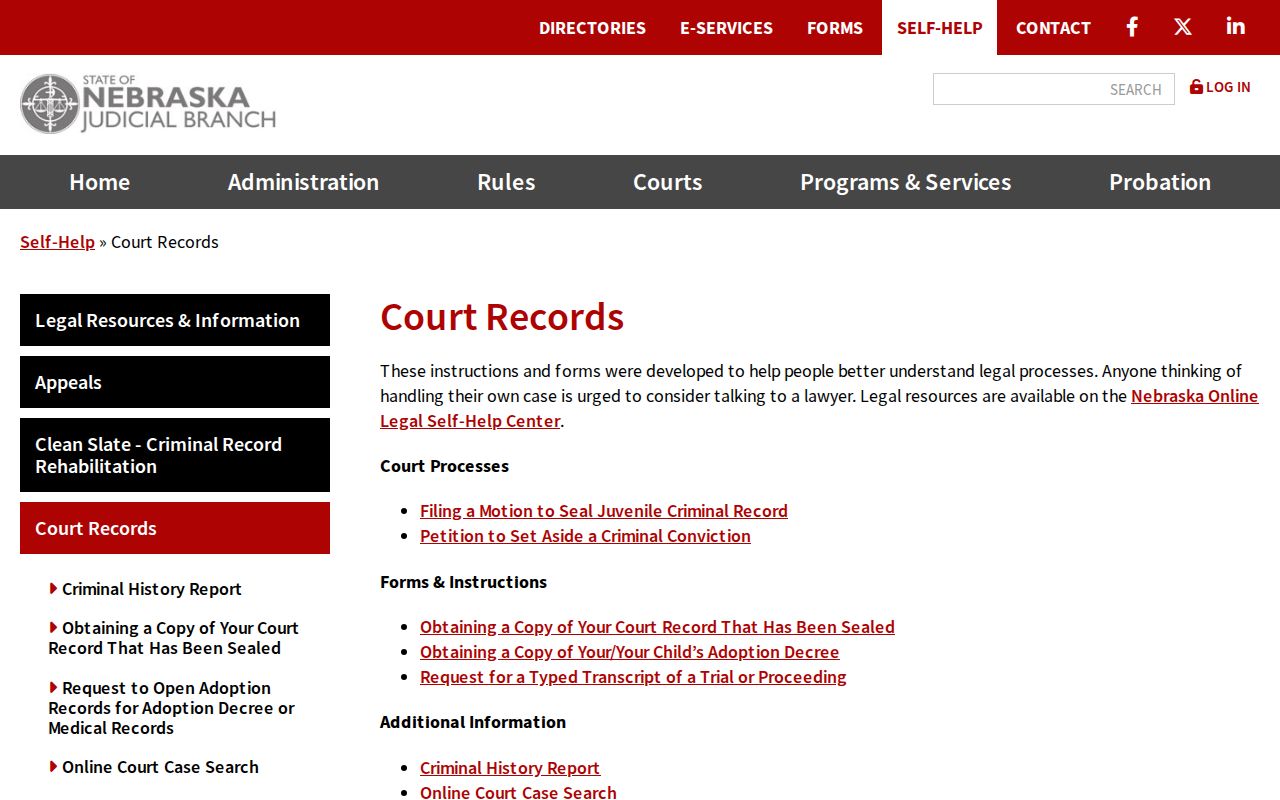
Court records requests go faster once the docket gives you the court, the case number, and the exact document needed.
Civil Dockets: What They Show
A civil Register of Actions is an event history, not the whole file. It points to the complaint or petition, service, the answer, motions, and hearing notices. It also covers settlement or mediation activity, the judgment or order, costs, and any satisfaction or collection activity. The case summary adds context. It lists the caption, number, type, parties, attorneys, judge, and status. Those dates make the register readable.
| Case number | Nebraska uses CI for civil and SC for small claims, generally with year and sequential number. |
|---|---|
| Parties and counsel | Caption, parties, attorneys, court, case type, judge, status, and dates may appear in the summary. |
| Pleadings and service | The register can record complaint, petition, answer, summons, and service activity without reproducing every paper. |
| Motions and hearings | Motion, hearing, reset, continuance, mediation, settlement, or order entries show progress in date order. |
| Judgment and costs | A judgment, order, satisfaction, cost, or payment entry is distinct from the underlying filed paper or certified judgment. |
Need the result itself? Request the filed judgment, order, or other identified paper from the right clerk. A register line records an event. It does not replace the document behind it.
Chase County Civil Clerk Routing
Karen Mueller, Chase County Court Clerk Magistrate, keeps County Court civil and small-claims records. Wendy Moe, Chase District Court Clerk, keeps District Court civil records. Both sit at 921 Broadway, Imperial, NE 69033, and both take mail at P.O. Box 1299, Imperial, NE 69033. Their phone lines differ, though. County Court civil and small claims use 308-882-7519; District Court civil uses 308-882-7500. Both offices list Monday through Friday, 8:00 a.m. to 4:00 p.m.
When you call or write, give the court and the case number or year. Add the caption or party, a date range, the precise document, copy type, and how you want it delivered. The clerk sets no posted certified-copy turnaround or fixed certified judgment fee. Route by jurisdiction, not by the word civil alone. Staff can explain procedure, payment, deposit, delivery, or the available record route. They cannot give legal advice or complete forms.
Note: A request reaches the right office faster. Identify the court and document before anyone asks for a copy.
What Cases Fill the Civil Docket
Chase civil records are not one bucket. County Court handles general civil cases within its jurisdiction and separately tracks small claims, probate, guardianship or conservatorship, adoption, and juvenile matters. District Court civil records cover major civil litigation. Domestic relations and protection orders stand as their own District Court categories in the annual report.
- County civil: matters within the County Court’s $70,000 limit.
- Small claims: a separate County Court category with a $7,500 limit.
- Probate and guardianship or conservatorship: County Court categories that are not ordinary civil lawsuits.
- District civil: major civil cases kept by the District Court clerk.
- Domestic relations and protection orders: separate District Court categories.
Case type matters as a search filter. It stops a probate or small-claims question from being read as a general civil lawsuit. It also points a records request toward the clerk who keeps that file.
Chase District Civil Filing Context
FY2025 filing counts show the local mix, not a current docket or any party's outcome. Chase County Court reported 178 civil filings and 177 probate filings. It also logged 20 guardianship or conservatorship filings, three small claims, and five adoption filings for the year ending June 30, 2025. Civil and probate totals sit nearly even. That alone shows why a precise case type matters.
Chase District Court reported 11 civil filings and seven domestic-relations filings. Each sits in its own report category. A filing count cannot tell you whether a case is active, reached a hearing, or ended in judgment, dismissal, settlement, or some other result. For those answers, turn to the Register of Actions and the filed orders.
The annual reports count cases filed from July 1, 2024 through June 30, 2025, not a real-time inventory or a list of final outcomes.
Hearings on the Civil Docket
Civil hearings show up in two places, and each does a different job. Nebraska's free calendar lists current and future settings for County Court or District Court. You can search it by a date or by a last name. A name search needs at least two characters. The calendar is not the full civil file.
One caution matters here. If a hearing was reset or continued, the old date may be stale. Track down the new setting. Then read the Register of Actions and any filed order to see what actually happened. JUSTICE and the clerk remain the best sources for case-specific filings and attorney details. Scheduling and data-entry timing vary by county. An empty calendar result does not mean no hearing exists.
Already have a case number? The Docket Search page walks through the differences. It covers how a calendar, case detail, and a clerk request differ.
Chase County Civil Docket Fee Tiers
Filing a Chase County civil case and pulling its records cost different amounts. The current statewide table sets County Court civil totals at $62, $72, and $82. The tiers split by state-docket tier. District Court civil filings carry a base total of $144. Small claims start at a base of $58.
Those numbers cover filing only. They do not promise that a copy or certification will match the filing price. Check the effective dates and local practice with the court before you budget a request.
| County civil filing tiers | $62, $72, and $82 in the current table. |
|---|---|
| Small claims base total | $58, separate from County Court civil tiers. |
| District civil base total | $144 in the current table. |
| Plain photocopy | $0.25 per page. |
| Certificate and seal | $1 for a certificate and seal; $3 for an authenticated certificate with three seals. |
The Judicial Branch’s filing-fee and court-cost table is the source for these figures.
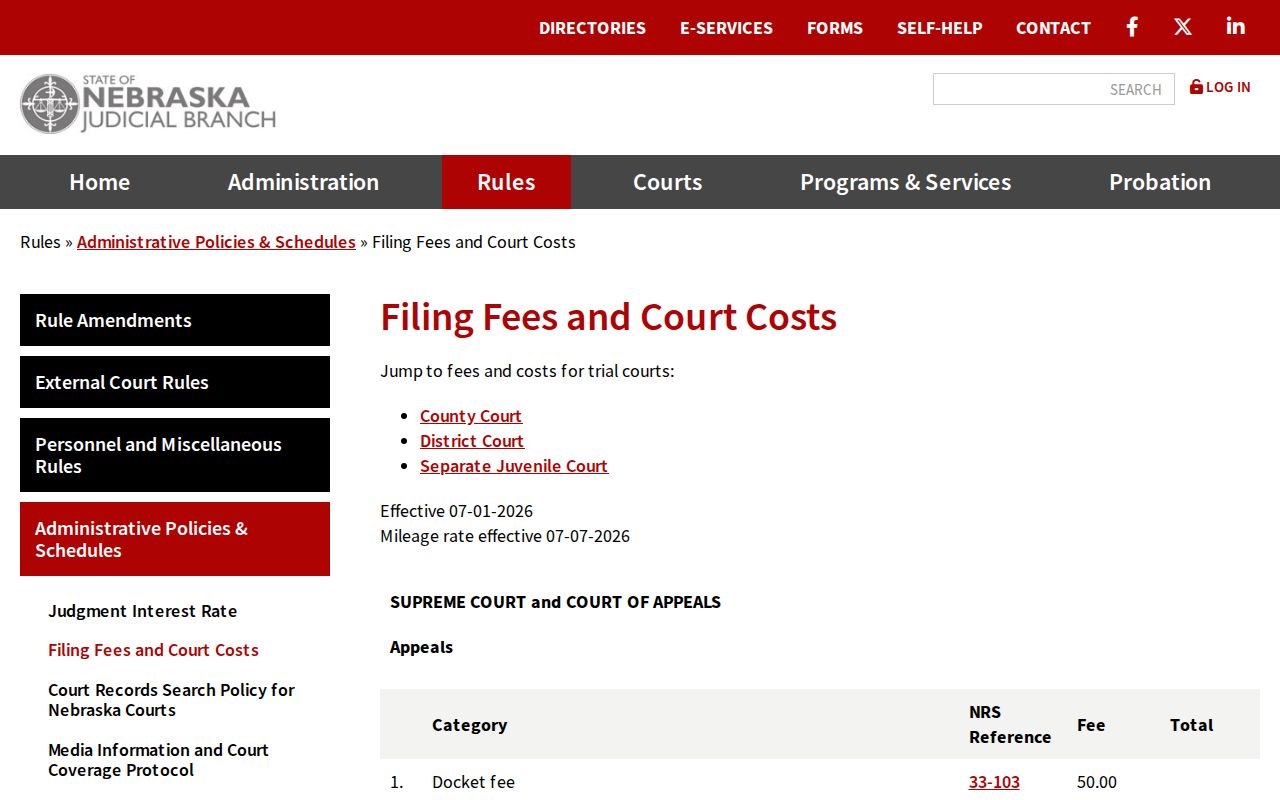
Chase County posts no fixed fee for a certified docket, a judgment copy, a staff search, a deposit, mailing, or turnaround time. Ask the clerk who handles the record for those numbers.
Note: Filing totals and record-copy charges serve different purposes; a court filing fee does not establish a request fee.
Who Can See Civil Dockets
Nebraska's public-access rules back both inspection and copies, subject to lawful exceptions and charges. Rules §§1-803 through 1-805 cover equal access, remote and terminal access, and electronic indexes, summaries, Registers of Actions, calendars, orders, decrees, and available images. The Chase courthouse keeps a public-access terminal open during business hours. Its room and printing setup are not published. Ask the clerk on arrival.
Civil record access:
Nebraska Supreme Court Rule §1-804 describes general remote and courthouse access.
Nebraska Supreme Court Rule §1-808 excludes sealed, confidential, adoption, juvenile, and other protected information.
Nebraska Supreme Court Rule §6-1464 protects civil personal and financial information that parties and counsel must redact.
Seeing a civil docket remotely changes nothing about a protection or sealing order. Nor does it turn a financial entry into a certified judgment or an available image into the whole case file.
Chase County Civil Privacy Redactions
Rule §6-1464 shields dates of birth, gender, Social Security numbers, financial-account numbers, and other civil personal or financial information, placing the redaction duty on parties and counsel. So a public civil case may show a visible summary or register while a document image stays unavailable, redacted, sealed, or missing from online detail. The court record and the privacy rule coexist, and both shape what a docket search returns.
When the needed item is the judgment itself, request that filed judgment or order by court, case number, document date, and copy type. For an older paper, ask the clerk about the court file, retention status, or another record route. Chase County's Archives RG219 collection covers 1886 through 1977 on 58 microfilm reels, though the collection's scope does not prove a court record never existed.
A specific request works best: name County Court or District Court, identify the document, say whether inspection, a plain copy, or certification is sought, and ask about delivery and payment. That respects the public-record route and the privacy limits that can affect civil docket detail.
Note: A public case summary does not guarantee that every underlying civil document is viewable, available online, or unredacted.