
How the Chase County Court Calendar Works
Start with the free Nebraska court calendar. The tool asks you to pick County Court or District Court. Then you choose a court, a search mode, and a search value. It covers current and future settings only. The paid JUSTICE case-information service is a separate product. A calendar hit is not a case register or a filed order.
Know which court holds the case before you search. Chase County Court takes traffic, misdemeanors, ordinance matters, small claims, probate, and juvenile matters. It also hears county civil cases within the state limit. Chase County District Court handles felony, major civil, domestic-relations, and protection-order work. A docket entry showing a court date is just a scheduled event. It is not proof that any filing was decided.
Timing matters too. Local scheduling and data entry can lag. A blank result does not prove that no hearing exists. A setting on the calendar can still be moved by a later continuance. A signed order or a clerk's confirmation can move it too.
Chase County Court Schedule Portal
The form is free and open to anyone. For an upcoming Chase County Court or District Court setting, start with the court type. Then pick the court, choose By Date or By Last Name, type the search value, and hit Search. Reset clears everything. A last-name search needs at least two characters, so one letter returns nothing useful.
The official statewide calendar form shows the Court control. It also shows the search-mode controls used for Chase County court schedule lookups.
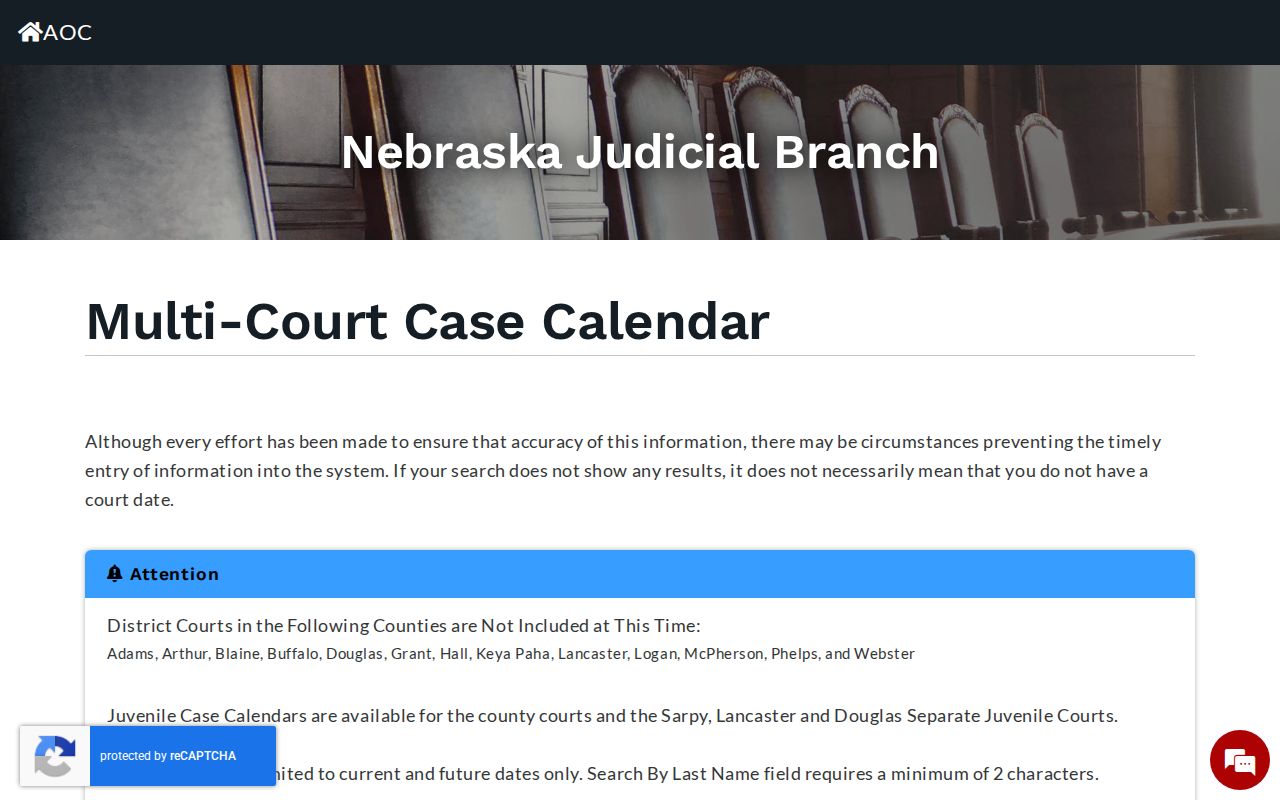
Treat the form as a locator. Once it returns a date, compare the court and party details before you rely on it.
Calendar access is separate from Nebraska eFiling. E-filing serves authorized users who need to file and serve documents. The public calendar just shows settings. For case-specific attorney information, filed documents, or the history behind a hearing, turn to the register, a JUSTICE search, or the responsible clerk.
Chase County Court Date Lookups
Do not lean on a single source when a Chase County court date matters. The calendar is the fastest route to a current or future setting. But other channels exist. Keep the notice, citation, or order you already received. Check the online result against it. An attorney on the case can also confirm the setting. That attorney can catch any change filed after you searched.
- Open the statewide calendar and choose County Court or District Court, then select the court and search by date or last name. Enter at least two name characters when using the last-name mode.
- Read the resulting setting with the case and party information in hand. For case-specific history, use JUSTICE or request the register from the correct clerk rather than assuming the calendar is the full file.
- Call or visit the appropriate clerk counter if the online search is blank, ambiguous, or older than the event you need. Karen Mueller keeps County Court records; Wendy Moe keeps District Court records.
- Check any courtroom or courthouse posting and listen for a docket call when one is used for that setting. Ask the attorney of record to confirm a party's required appearance and any revised notice.
Chase County posts no separate local daily printed calendar and offers no automated reminder service. A courthouse posting or docket call can still help on the day of court. Treat those as confirmation only. They are not a substitute for the calendar, the order, the clerk, or the attorney.
Note: A citation may carry the controlling initial date for a traffic matter. That matters most when the online calendar has not yet caught up.
Chase County Schedule Search Modes
The two search paths answer different questions. Search by date when you know the day and want to see what is scheduled. Search by last name when you know the person but not the date. Either way, select the right Chase County court type and court first. Then read any result.
| Calendar choice | What to enter | Best use | Important limit |
|---|---|---|---|
| County or District Court | Choose the court type, then the court | Put the case in the right trial-court track | A case may be in a different court than expected |
| By Date | A calendar date in the form's search field | Review current or future settings for that day | It does not provide a complete case history |
| By Last Name | At least two name characters | Look for a named party's scheduled setting | Spelling and recent entry timing can affect results |
| Reset | No value | Clear an incorrect court or search value | It does not change any court setting |
Short and common names need extra care. Match the result against a case number or other solid paperwork when you can. A name match alone never proves a case belongs to a particular person.
Court Settings: What Each Field Means
A setting is a scheduled court event. The calendar tells you when a case is listed. It does not reproduce every filing, motion, or order in the case file. Read any location or judicial officer field exactly as shown. Do not assume a courtroom, floor, or building assignment the calendar never displays.
| Date | The scheduled calendar day. A filing date is different from a hearing date. |
|---|---|
| Time | The time listed for the setting. It may identify a calendar call or a case setting, so confirm any attendance requirement with the court or attorney. |
| Court or location | The court selected on the calendar and any location shown in the result. No specific Chase courtroom assignment should be assumed if it is not displayed. |
| Judge | A judicial officer only when the calendar or case information identifies one. Judge notes are case-management information, not filed orders. |
| Setting type | The event label, such as hearing, arraignment, pretrial, or trial, when supplied. The case register and order give the fuller context. |
Each tool answers a different question. The calendar shows what is scheduled. The Register of Actions is the chronological list of filings and events. The case file holds the actual documents. Those distinctions matter when an event label appears without the motion, order, or notice that explains it.
Chase County Court Schedule Warnings
A no-result message is not a final answer about a Chase County hearing. The Judicial Branch warns that local scheduling and data-entry timing vary. A matter that was recently scheduled, moved, or entered may not appear as expected, and the public calendar covers current and future settings rather than serving as a full archive.
Calendar result rule. A blank calendar search does not prove that a Chase County court setting was canceled, never set, or no longer requires attention. Confirm it with the notice, register, attorney, or correct clerk.
The Judicial Branch's calendar information page spells out the local-scheduling warning that applies to statewide calendar searches.
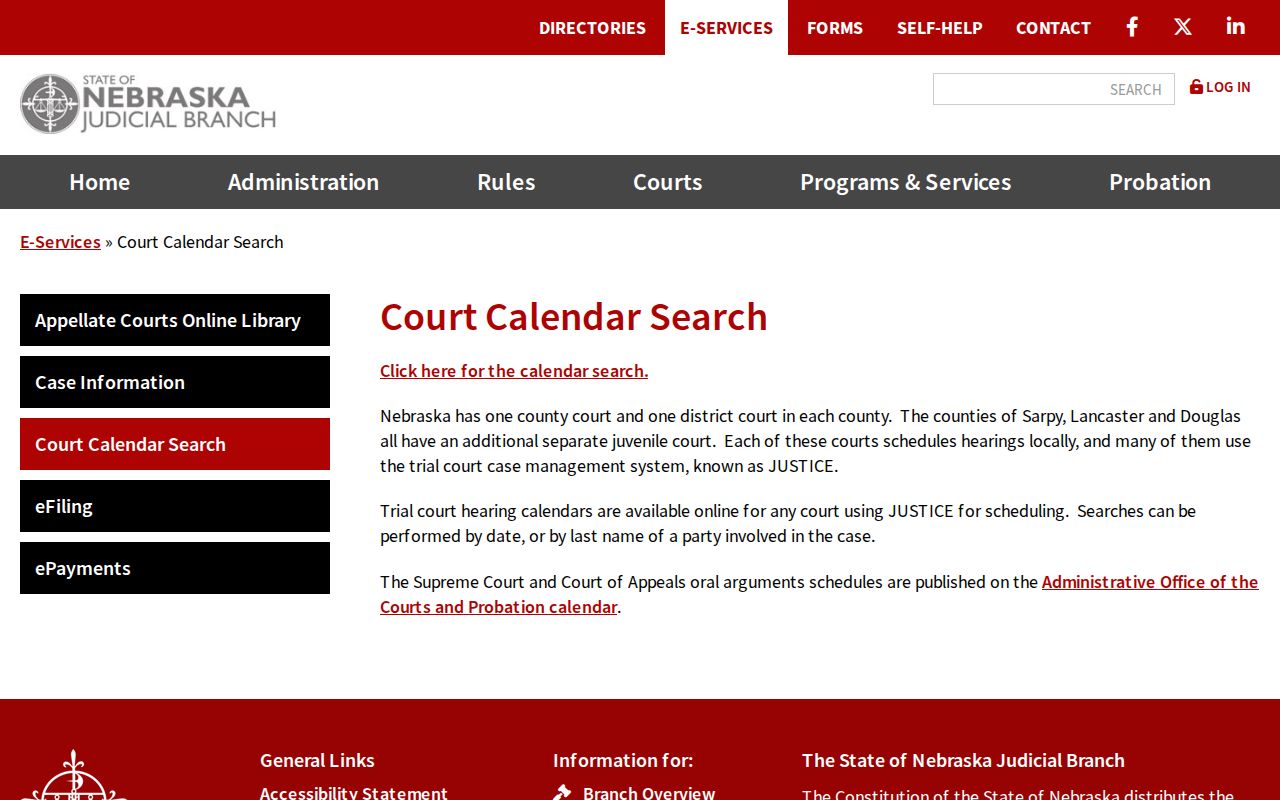
A calendar warning gives you time to react. Pair it with the filings and the contacts that fit the particular case before acting on anything. That warning alone does not settle the matter.
Note: Court staff can explain procedure and access routes, but they cannot give legal advice or decide what a party should file.
When a Court Date Moves
A reset or continuance only moves a setting. It does not decide the case or erase the earlier calendar entry. Once you learn a Chase County court date has moved, track down the replacement setting. The court docket points the way. But read the register or a filed order for the event history. The earlier date may no longer count.
Chase County offers no online procedure for requesting a continuance. It promises no guaranteed update interval either. So follow the instruction on a notice or order. Then ask the attorney of record. Or ask the responsible clerk about the status of the scheduled event. Do not infer a new date from an old citation. Do not rely on a past calendar result or an unfiled conversation either.
For County Court records, contact Karen Mueller at Chase County Court. District Court matters belong with Wendy Moe at Chase District Court. Both offices sit at 921 Broadway in Imperial. Each is listed as open Monday through Friday. The hours are 8:00 a.m. to 4:00 p.m. The two courts keep separate records.
Chase County Schedule After a Reset
After a reset, the calendar and the register do different jobs. The calendar finds the replacement setting. The JUSTICE case detail can show register entries, hearings or orders, financial entries, and qualifying images. A filed order is the stronger source for the court's actual direction. Ask the clerk for it. Do not rely on judge notes alone.
- Setting
- A scheduled court event shown on a calendar.
- Continuance or reset
- A change that moves a scheduled event to another setting.
- Register of Actions
- The chronological list of case filings and events.
- Disposition
- An entry recording an outcome or action, not merely a scheduled date.
The state's JUSTICE demonstration frame shows its case-information system.
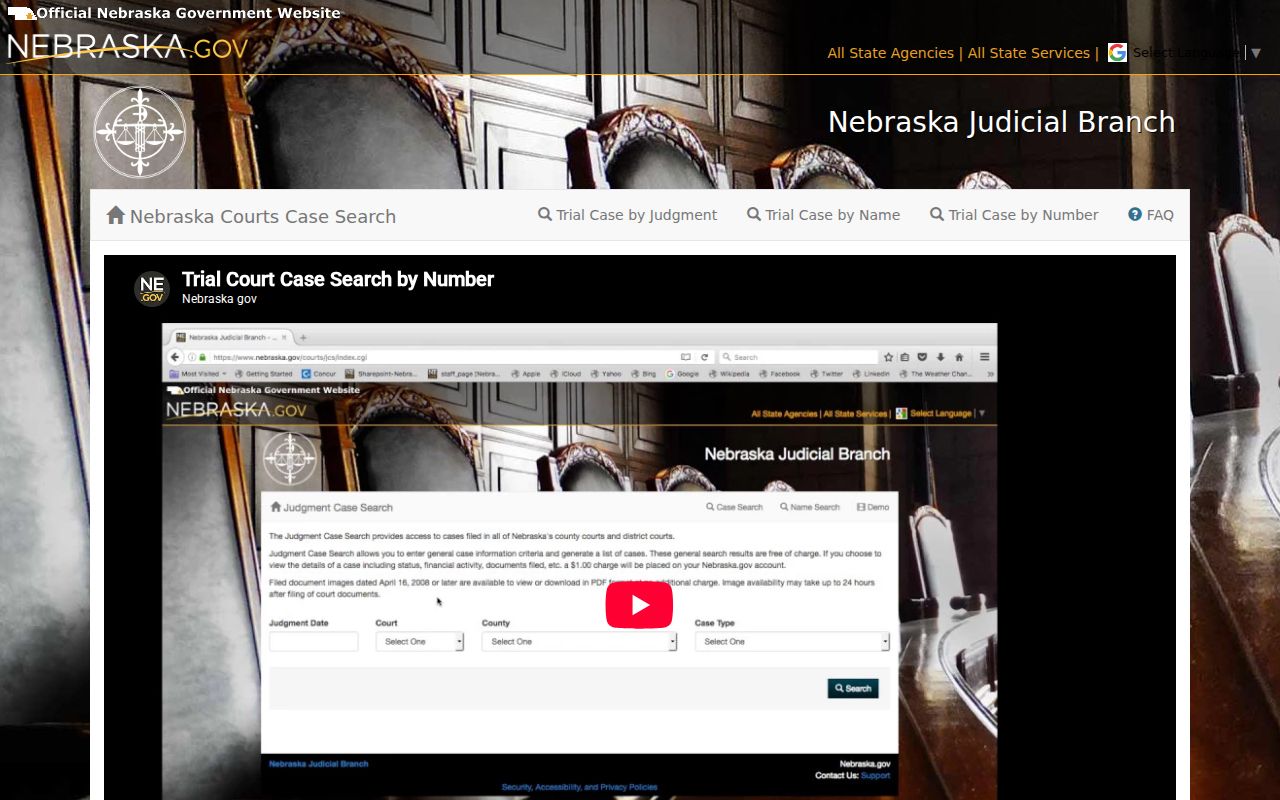
That demonstration is not a Chase County result. It still shows why the calendar alone is not the complete case record.
Missed Settings and What Comes Next
Act quickly after missing a Chase County court setting. Keep the citation, notice, or order at hand. Figure out whether the case sits in County Court or District Court. Contact the attorney of record if there is one. Chase County publishes no rule fixing every consequence of a missed appearance, so an online calendar result alone will not answer that question.
Missed a Setting? A missed Chase County hearing can require prompt action, and the citation, notice, filed order, and court record control what happens next.
Contact the responsible clerk or attorney immediately to verify the case status and the court's next required step.
Seek advice from a licensed attorney about an absence before appearing or filing anything in response.
For a traffic matter, the citation controls. It states whether waiver is allowed. It also gives the appearance information that applies. When appearance is required, when there are multiple offenses, or when no waiver is offered, use the citation and call County Court for procedure. Do not assume a missed-setting rule, a warrant, a license consequence, a payment plan, or an amnesty program unless Chase County official sources say so.
Chase County Court Schedule Fallback
When the calendar leaves the question open, work the access path in order. Start with the calendar. Move to a JUSTICE search when case detail is needed. Then try the courthouse terminal or the correct clerk. Under Nebraska policy, that public-access terminal is available at the Chase courthouse during business hours, though the court does not publish the room, the printing process, or its staff-assistance practice. A clerk can also explain inspection, plain-copy, certified-copy, transcript, and audio-request routes.
First confirm the correct court, record, delivery method, and payment details. Then mail the request. The address is P.O. Box 1299, Imperial, NE 69033. County Court answers at 308-882-7519, and District Court answers at 308-882-7500. The next layer of case lookup is the Chase County Docket Search, which explains the paid name search and subscriber options. The calendar remains free. But it cannot stand in for a full register or an official certified record.
Note: Bring the court, case number, year, type, party name, date range, and the exact record or setting question when contacting a clerk.