
Chase County Court Docket Searches
Chase County handles its public case information through Nebraska's statewide court services. Start with the free calendar. It answers the question of when something is set. Use JUSTICE Trial Court Case Search when you need a party name, a case number, or the Register of Actions attached to a specific Chase County case. Each tool answers a different question. Match the tool to the question and you save yourself a detour.
Before searching a Chase County court docket, gather the party name, the likely court, the case type, and any case or citation number. A party name works better than a witness name. Recent filings may lag. Sealed or confidential cases, and older ones too, may take a call or a visit to the clerk instead of another web search.
- Use the free calendar to check a current or future Chase County setting by date or last name.
- Open the paid JUSTICE search when a party or case record is needed.
- Narrow a Chase County result by court, case type, year, or case number when those details are known.
- Read the Register of Actions for filings, settings, orders, costs, and disposition entries.
- Ask the correct Chase County clerk for inspection, a copy, a transcript, audio, or certification when the online result is not enough.
Note: A Chase County calendar result gives you a date. It is no substitute for the complete case file.
Chase County JUSTICE Search
JUSTICE is Nebraska's statewide trial-court case system. The one-time search costs money. The charge is $17. That buys a party-name search with results covering up to 30 cases, and access stays open for three calendar days. Entries can lag about 24 hours. Careless spelling costs you, because a no-result response still carries the search charge.
The Judicial Branch case-information service lays out the available case detail, subscriber access, and image coverage. A Chase County case detail may list a summary, parties, offense information, financial entries, hearings, orders, judge notes, and qualifying images. Nothing restricted becomes public.
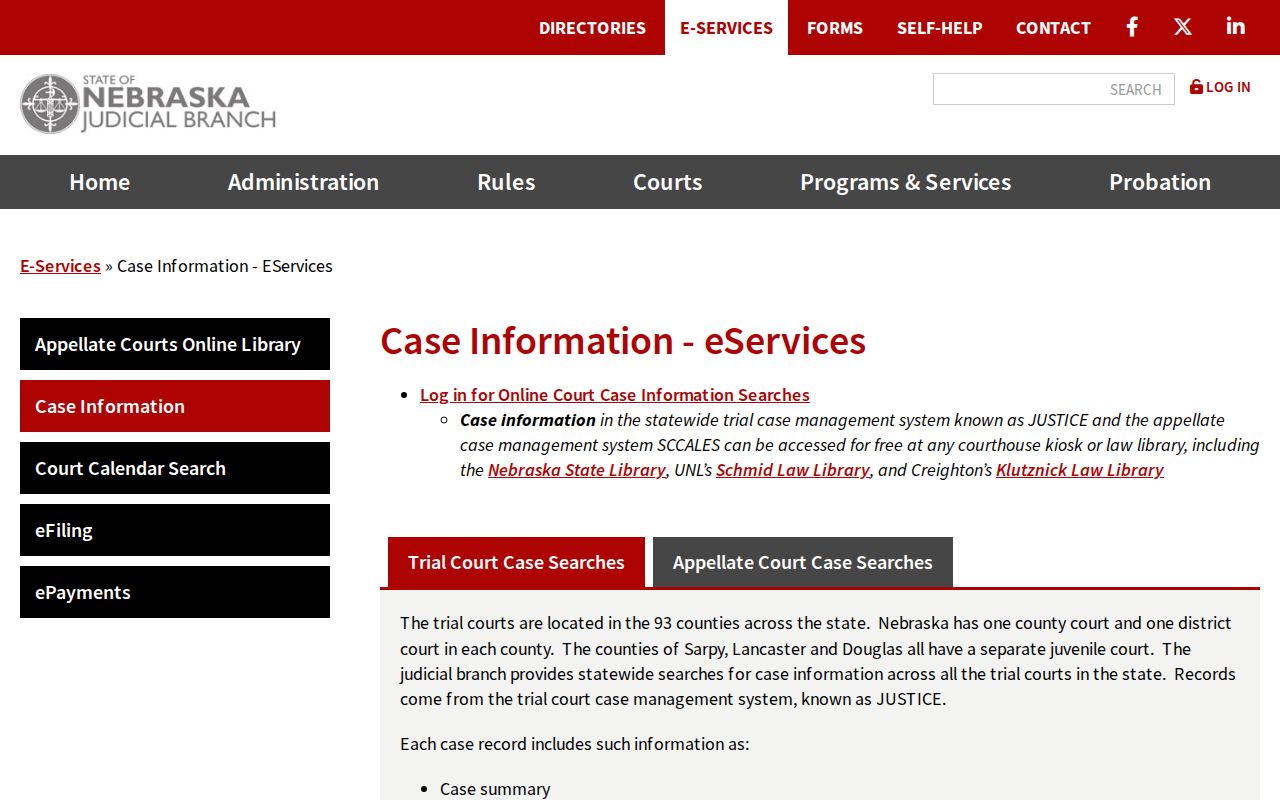
Repeated Chase County work justifies a subscriber account. It filters by party, court type, case type or subtype, county, year, judge, attorney, case number, and judgment date. Subscriber case detail carries its own $2 charge. Nebraska eFiling is a different animal: it moves filings and e-service, not the public Chase County court docket.
Court Dockets: What They Show
Nebraska has an official term for the chronological event list. It is the Register of Actions. A calendar is a snapshot. In a Chase County case, the register separates a filing from a hearing, a hearing from a reset, and an order from the document image that may support it. The calendar shows scheduled cases at a point in time, and the Register of Actions records the case activity over time.
| Case number | A type, year, and sequential identifier; common type codes include CI, CR, PR, TR, JV, and SC. |
|---|---|
| Case summary | The caption, parties, court, case type, judge, attorneys, and status shown for a Chase County matter. |
| Register entries | Chronological filing, service, motion, hearing, continuance, order, judgment, cost, and payment events. |
| Hearing setting | The listed date, time, location, and setting type; a later reset can replace it. |
| Disposition | An outcome entry or order, not a promise that every later filing or payment issue is resolved. |
| Images | Underlying documents when they are available and not excluded from public access. |
A citation number is not the same thing. The two formats differ. The uniform citation runs up to two letters and seven numerals without leading zeros, while the Chase County court case uses its own type-and-year vocabulary.
Chase County Register Terms
A filing date tells you nothing about when the court will hear the case. Issued service is not completed service. A scheduled setting is not a decision. These distinctions earn their keep whenever a Chase County court docket shifts after a continuance.
- Register of Actions
- The chronological list of court events and filings in a Chase County case.
- Setting
- A date and time assigned for a court event, subject to a later order or reset.
- Continuance or reset
- A change that moves a Chase County setting; the replacement date should be checked.
- Disposition
- An entry showing an action or outcome, often tied to a filed order or judgment.
Costs and payments are financial record entries. They are not a certified judgment. Nor are they a Department of Motor Vehicles driver record. For the signed decision in a Chase County case, ask the clerk for the filed order behind the register entry.
Chase County Courts and Their Dockets
Chase County splits its trial courts in two. County Court comes first. It handles traffic, misdemeanors, infractions, ordinance complaints, county civil matters, small claims, probate, guardianship, conservatorship, adoption, and juvenile matters. District Court holds the Chase County record for felony work after county proceedings, major civil cases, domestic relations, protection orders, administrative appeals, and district-level appeals.
| Court | Docket covers | Where to search |
|---|---|---|
| Chase County Court | Traffic, misdemeanors, ordinance matters, county civil, probate, small claims, and juvenile matters. | JUSTICE, the calendar, courthouse terminal, or Karen Mueller, County Court Clerk Magistrate. |
| Chase County District Court | Felony, major civil, domestic relations, protection orders, and district appeals. | JUSTICE, the calendar, courthouse terminal, or Wendy Moe, District Court Clerk. |
| Nebraska appellate courts | Appeals from trial courts. | The Nebraska Supreme Court and Nebraska Court of Appeals use their separate appellate system. |
One wrinkle exists. City and village ordinance complaints may be prosecuted in County Court, and Chase County runs no separate municipal, justice-of-the-peace, police-magistrate, or stand-alone juvenile docket.
Choosing Chase County Court
The word "court" in a search result will not pick your counter. The case does. Karen Mueller keeps the County Court records. That covers traffic, misdemeanor, ordinance, county civil, probate, guardianship, adoption, and juvenile. Wendy Moe handles the District Court side. That covers district civil, felony, domestic-relations, protection-order, administrative-appeal, and district appellate records.
Chase County's county-offices page places both court offices at the county-office location in Imperial. So bring the right details. A case number, court type, year, party name, date range, and the exact document needed give the clerk a clear start. That holds whether the question arrives by mail, fax, or in person. Procedure questions follow the same split.
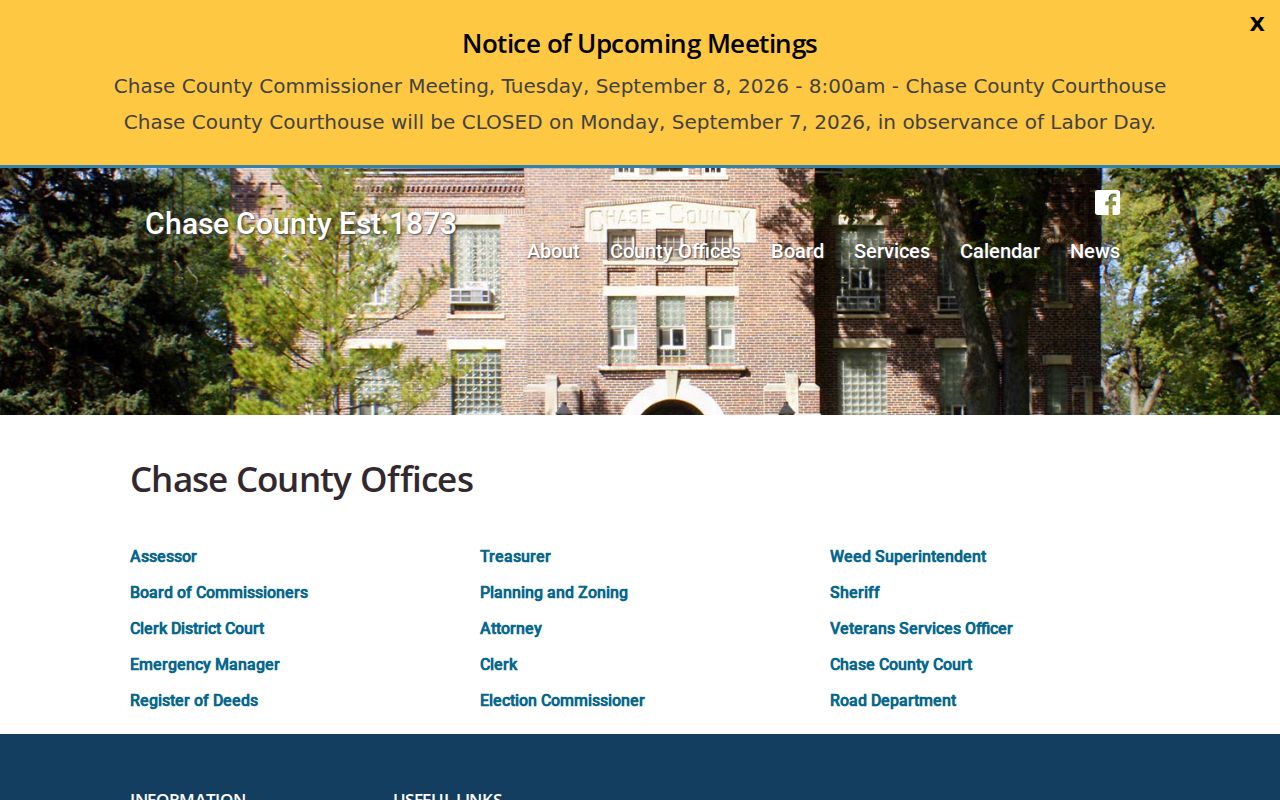
The Chase County courthouse is the physical fallback. A public-access terminal there serves visitors during business hours. The clerk can explain the terminal room, printing process, and staff-assistance practice, since those details are not published.
Court Dates and Settings in Chase County
The free Nebraska Court Calendar is the first stop for any Chase County setting, current or future. The search takes three steps. Choose County Court or District Court, then pick the court. From there, search by date or by last name. Last names need at least two characters. The calendar names scheduled matters. The Register of Actions and filed orders supply the deeper case context.
Chase County court dates move. Expect that. When a calendar setting and a later docket entry disagree, hunt for a continuance, reset, or later order. Then confirm the new setting with the court. The Chase County court schedule covers the full search process for dates and rescheduled matters.
Chase County Calendar Warning
A blank result proves nothing about a Chase County hearing. The calendar looks forward only, to current and future settings. Local scheduling and data-entry timing can lag. A date can also reset after the query. That is why the Chase County fallback chain starts with the calendar. But it never stops there.
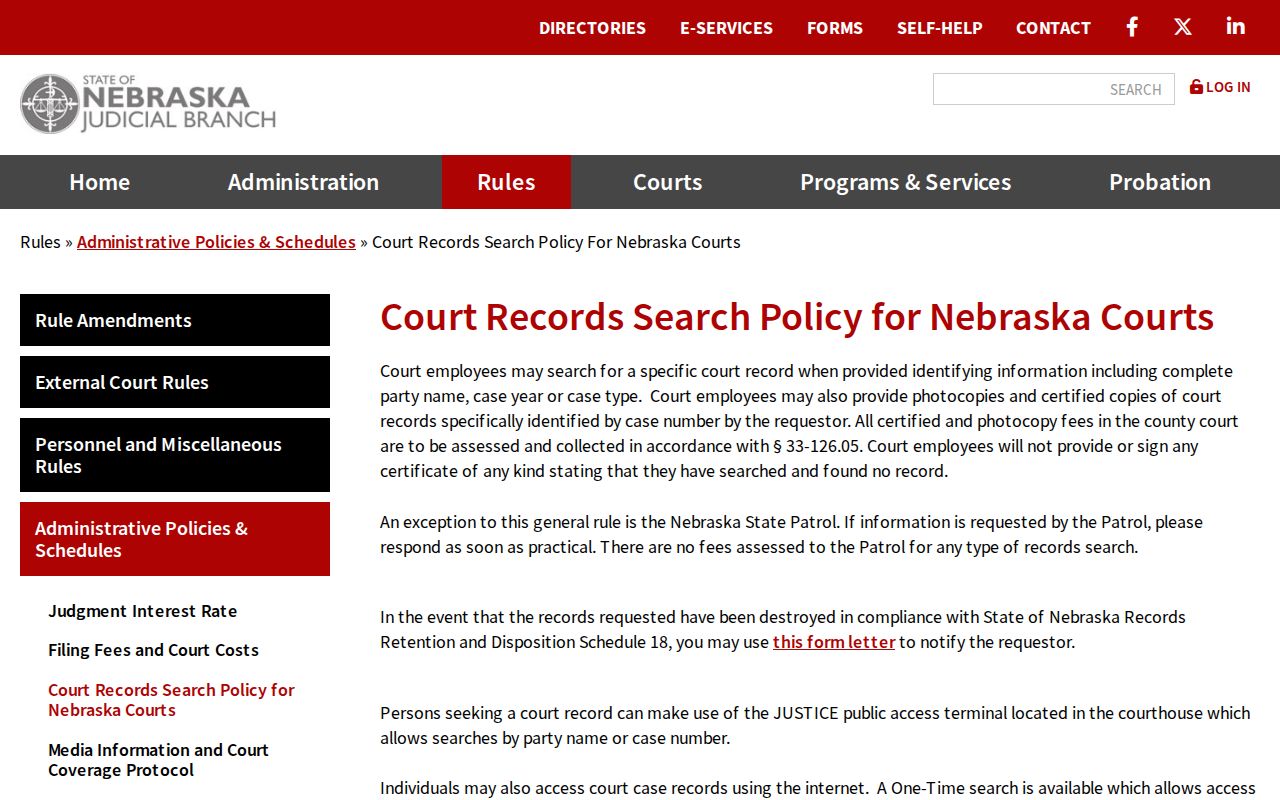
Nebraska's court-records search policy sets out online search, public-terminal access, copying, and formal records-request routes. For a missing setting, an older record, or a restricted case, go to the County Court or District Court clerk. The clerk also handles requests for court-certified documents.
Write down your search details first. When you contact a Chase County clerk, give the court, the case number or party, and the date range. Name the calendar or Register of Actions entry that needs confirmation.
Docket Access Under Nebraska Law
Nebraska court-record rules and the state's inspection and copy law govern public access to a Chase County court docket. The rules open up indexes, case summaries, registers, calendars, orders, decrees, and qualifying images within defined limits. Sealed material stays sealed. Confidential cases never become public search results.
Key rules for Chase County records:
Neb. Rev. Stat. § 84-712 supports inspection and copies of public records, subject to lawful charges and exceptions.
Rule § 1-803 provides the baseline of equal public access to court records and information.
Rule § 1-805 addresses electronically available indexes, registers, calendars, orders, and images.
Rule § 1-808 excludes sealed, confidential, adoption, juvenile, criminal-history, and other restricted information.
A Chase County search can come back incomplete. Juvenile and adoption matters, sealed cases, and protected personal or financial information stay out of public results. An outage can cut off remote access too. Court staff will explain procedure and records routes, but they cannot give legal advice or complete a party's forms.
Chase County Filing Context
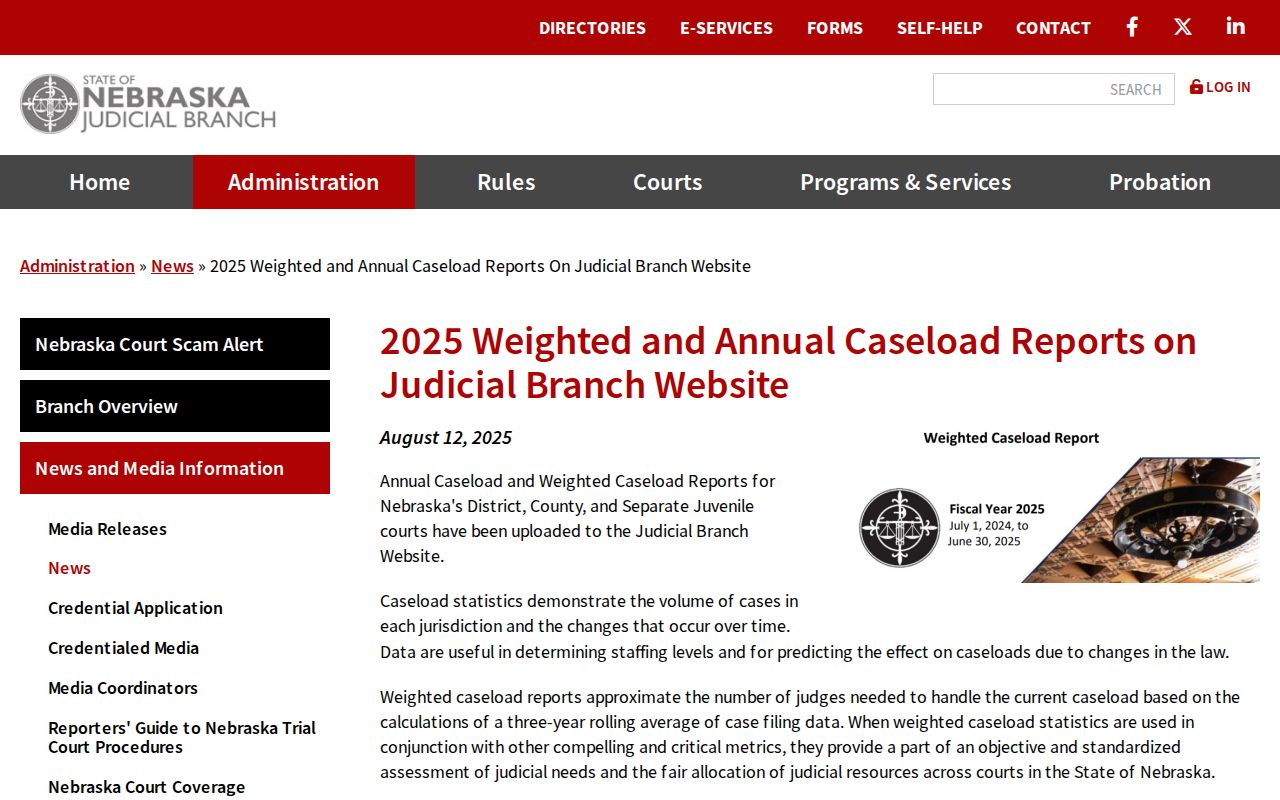
Chase County's FY2025 County Court total came to 511 filings. That count spans July 1, 2024 through June 30, 2025. It is a tally of filings, nothing more. So it does not measure people, convictions, pending cases, or likely outcomes. The docket mix for County Court included civil, probate, traffic, guardianship and conservatorship, small claims, adoption, misdemeanor, and juvenile categories.
County Court and District Court differ. Each keeps its own court records. For a Chase County docket search, that line matters more than any filing total.
The Judicial Branch's FY2025 report release explains that annual and weighted caseload reports support staffing and planning across the courts.
Local totals give Chase County context. Every Register of Actions still has to be read as its own case record.
How the Clerk Keeps Docket Records
Both Chase County clerk offices share a mailing address but keep separate court files. Help the clerk identify the record. Give the court, the case number, the case type, the year, and the party or caption. Add the date range and the document. Say whether you want inspection, a plain copy, certification, a transcript, or audio, since each is a different court-record service. Mail requests go to P.O. Box 1299, Imperial, Nebraska 69033. Each court has its own phone and fax line.
Chase County Court and District Court
921 Broadway
Imperial, NE 69033
County Court: 308-882-7519
District Court: 308-882-7500
Monday-Friday, 8:00 a.m.-4:00 p.m.
Chase County offers several records channels beyond the online docket search. Start at the counter. There you can ask for Register of Actions inspection, a case-file review, a plain or certified copy, a transcript, or available audio. A mailed request should name the court. Send it to P.O. Box 1299. County Court fax is 308-882-7554, and District Court fax is 308-882-7552. Use the uniform cover sheet and confirm acceptance, especially for a transmission over ten pages. The county clerk email, clerk@chasecountyne.gov, answers procedure and fee questions. It is not a promise of electronic file delivery. Nebraska's court policy also sets out a formal public-record request route through the clerk and the State Court Administrator.
A phone call suits a Chase County routing question. It also works for a missing docket entry. Ask the clerk for the preferred request details, and state which court you believe holds the file before asking about access. A call never replaces a written filing, a court order, or an official copy request.
Costs are set by rule, not guesswork. Statewide charges include $0.25 per photocopy page, $1 to execute a certificate and seal, and $3 for an authenticated three-seal certificate. Chase County lists no separate fees for certified dockets, judgments, exemplified copies, staff searches, deposits, mailing, or turnaround. Ask the responsible clerk before ordering.
Chase County Courthouse History
Chase County's records route has deep local roots. A wood-frame courthouse fire pushed the county to build the current one in 1910-12. The county moved in during January 1912. None of that changes a docket search. It does explain why the courthouse remains the Chase County anchor for clerks, paper court records, and terminal access.
The official Chase County homepage gives the county's government context and history. Older records may pose a retention or archival question rather than a JUSTICE query. The Chase archives guide covers 58 microfilm reels and 1886-1977 county records. They do not prove a court file never existed.
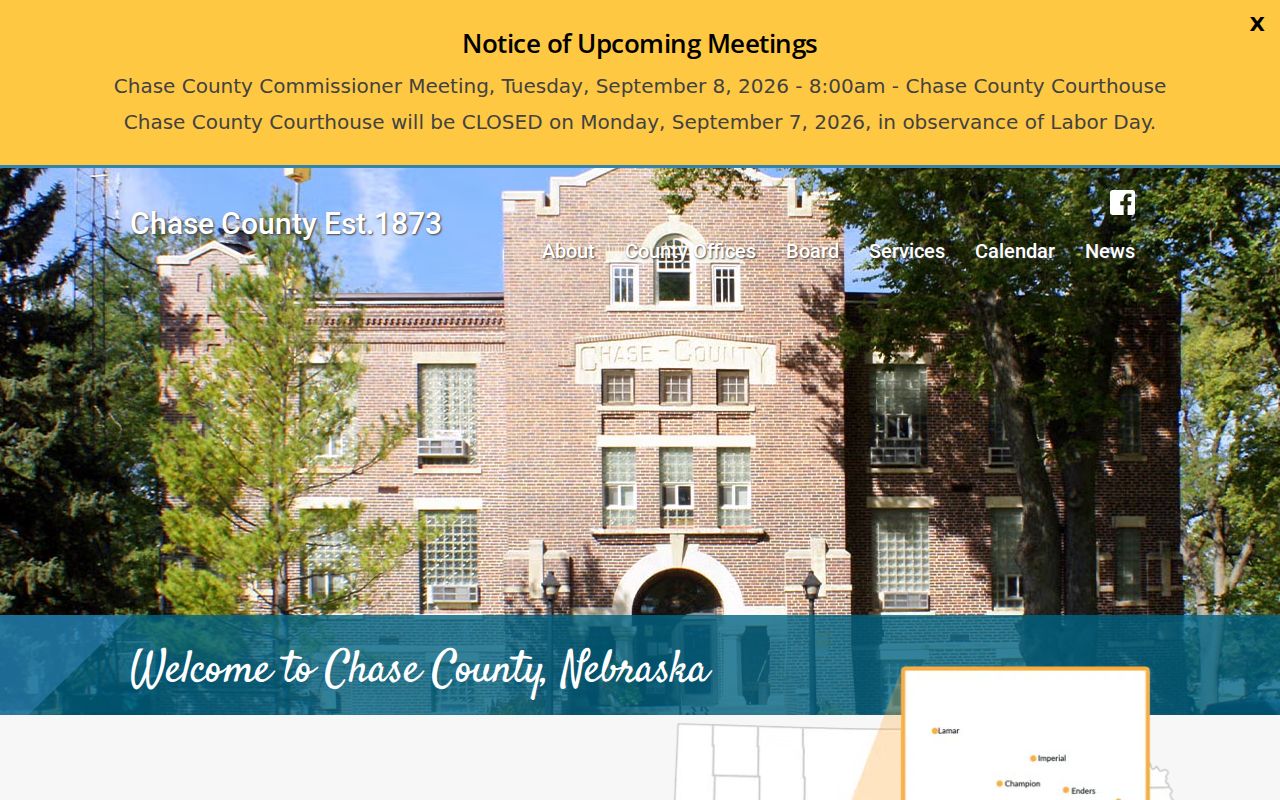
Start with the right clerk. For a historical Chase County record, ask whether the current file, a retention schedule, or the archives route is the best next step.
City-by-City Court Dockets in Chase County
Chase County has three incorporated places in the 2020 Census material: Imperial, Wauneta, and Lamar. Their municipal ordinances and local government records are not the same as a court docket. No city runs its own docket database here. For an ordinance complaint or a traffic court case, County Court is the court-record fallback; for a city minute or ordinance, ask the city or village office that keeps those records.
Imperial Court Records
2020 population 2,068. City records and County Court case records use different counters.
Wauneta Court Records
2020 population 549. Village ordinances are separate from the County Court register.
Lamar Court Records
2020 population 28. No separate Lamar court portal was verified.
Champion and Enders have no city governments, so neither one gets a city docket page. The three city pages that do exist stick to the real Chase County search chain, and no page invents a municipal court or portal that the county does not run.
Chase County Federal Dockets
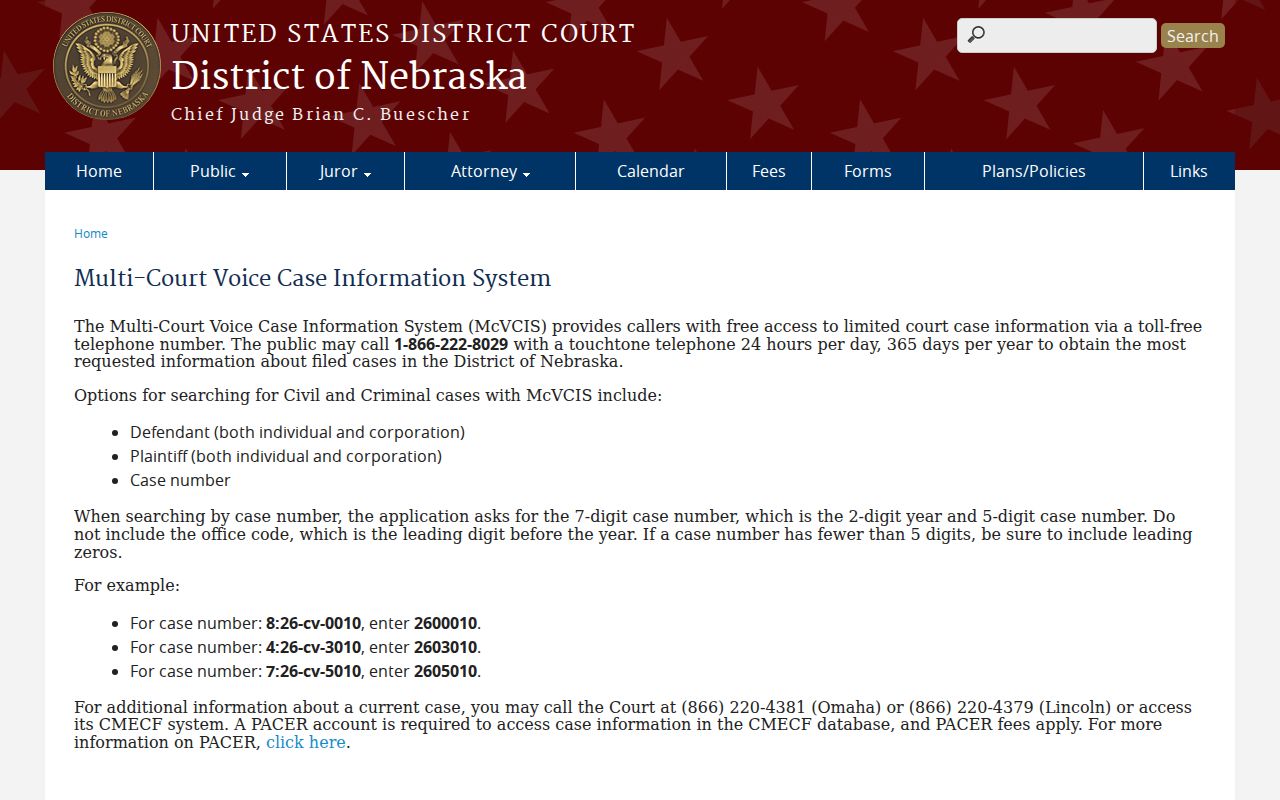
A few Chase County cases land in federal court instead of Nebraska trial court. The state JUSTICE system will not show them. On the federal side, the U.S. District Court for the District of Nebraska works through PACER and CM/ECF. A free phone line, McVCIS at 1-866-222-8029, runs 24 hours a day. It answers searches by civil or criminal party or case number. Treat the federal docket as its own record path. It is not a deeper layer of the Chase County court docket. District of Nebraska public-access information spells out the federal terminal and PACER routes. Those are the routes you can use.
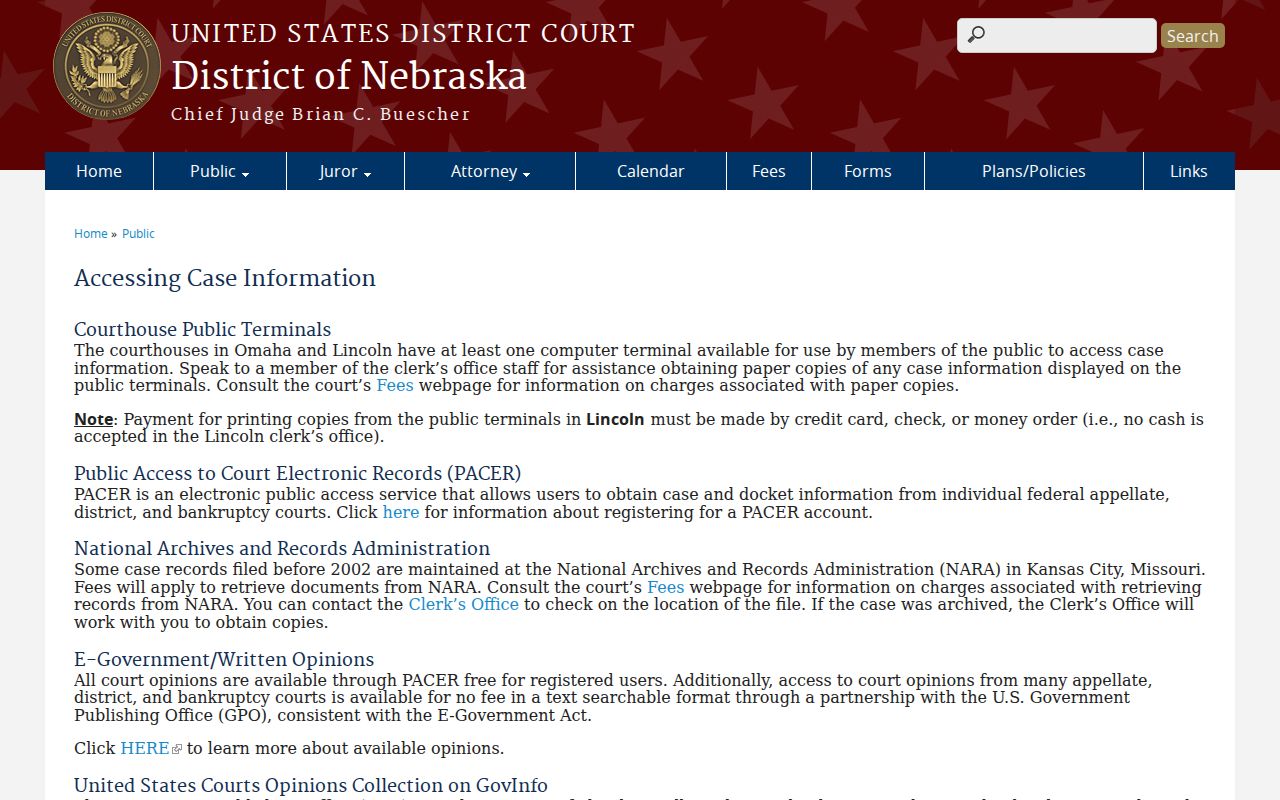
The McVCIS service is a federal voice-search option, not a Chase County clerk resource.
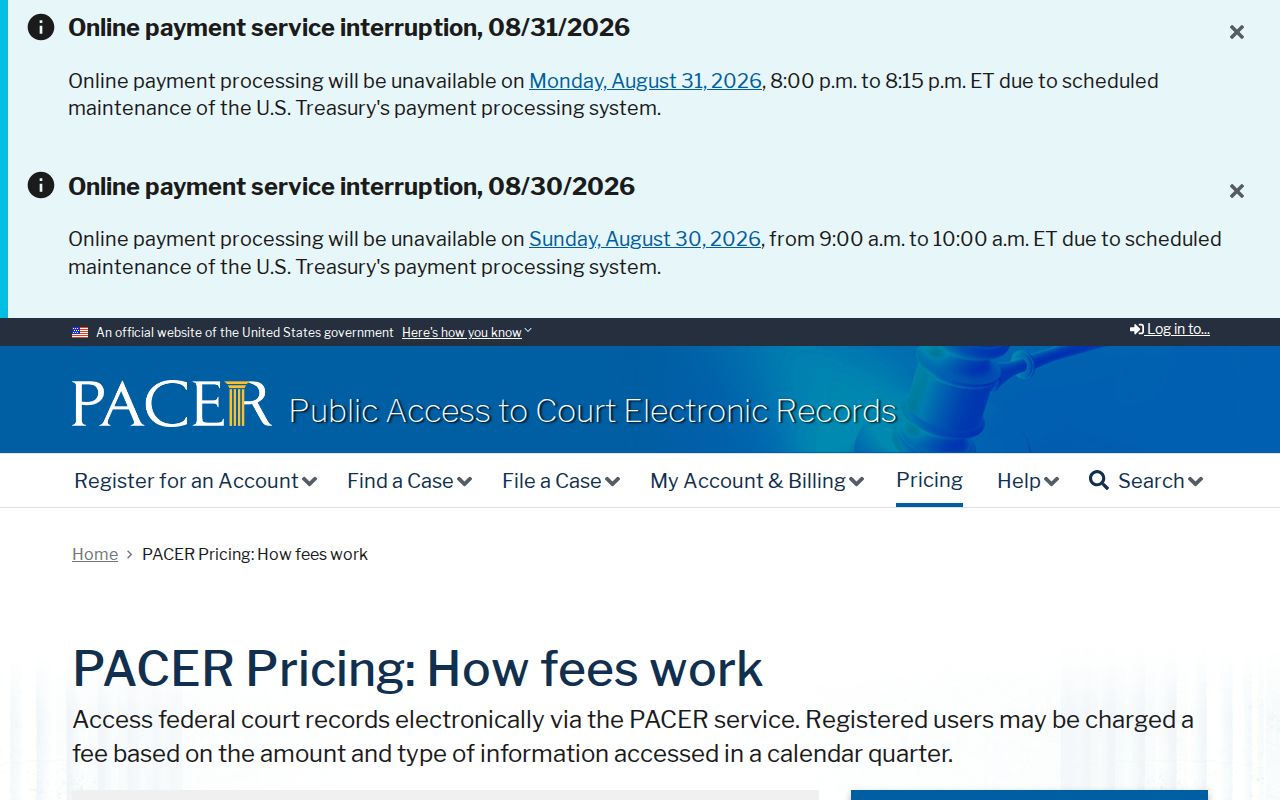
PACER's pricing page lays out the federal fee rules, from per-page charges to the quarterly waiver threshold. Ask each system separately: federal documents from the federal courts, Chase County case files from the county clerk.
Keeping state and federal searches straight saves real frustration. When a case number will not come back through a Chase County docket search, the case may simply live in the other system.
Map and Directions to the Chase County Courthouse
Chase District Court's felony, larger civil, and domestic-relations files and Chase County Court's traffic, misdemeanor, small-claims, probate, and preliminary-felony docket are both kept at the Chase County Courthouse, 921 Broadway in Imperial. The two clerks keep separate phone and fax lines but share the same building and the same 8:00 a.m. to 4:00 p.m. weekday hours. The current courthouse dates to 1912, built after an 1889 wood-frame courthouse burned.
Chase District Court
921 Broadway
Imperial, NE 69033
308-882-7500
Monday-Friday, 8:00 a.m.-4:00 p.m.
Chase County Court
921 Broadway
Imperial, NE 69033
308-882-7519
Monday-Friday, 8:00 a.m.-4:00 p.m.
Official sources do not publish parking, security-screening, ADA, or public-terminal room details for the courthouse, so calling the clerk ahead of a visit is the best way to confirm current access.