
Chase County Court Record Requests
First, know which Chase County court you are dealing with. District Court handles felonies, major civil cases, domestic relations, protection orders, administrative appeals, and district appellate files. County Court covers traffic, misdemeanors, ordinance cases, county civil, small claims, probate, guardianship, conservatorship, adoption, and juvenile matters. The JUSTICE One-Time search can identify a party case for a current fee. The free statewide calendar shows a current or future setting. Neither tool hands over copies. That still takes a clerk request.
When you make a Chase County court case records request, give the clerk the court, the case number, the case type and year if known, the party or caption, the document name or date, the scope you want, how you want it delivered, and whether you need a plain or certified copy. The courthouse public terminal offers another way to search during business hours. Callers and email writers can ask about procedure and fees. Electronic delivery of a file is not guaranteed.
- Identify the Chase County court that handled the case and write down the party name, case number, type, year, and document or date sought.
- Use the statewide calendar for a setting, or use JUSTICE One-Time or subscriber access to locate a public case, register of actions, and available detail.
- Inspect the Chase County court record at the public terminal or the correct clerk counter. Ask whether the register, case file, image, transcript, or audio is the item needed.
- For a mailed request, send the court-specific request to P.O. Box 1299, Imperial, Nebraska 69033. Ask the clerk about a deposit, mailing, payment, certification, and turnaround before sending funds.
- Phone, fax, or email the proper Chase County clerk for procedure. Fax requests need the uniform cover sheet, and more than ten pages require permission. If a formal public-record request is needed, the court policy describes a written route through the responsible clerk or State Court Administrator.
Note: A search result can help you find a file. It does not by itself create a certified Chase County court record.
Two Chase County Record Custodians
Chase County splits record custody between two offices, even though both sit at the county-office location. Pick the right counter. Otherwise a county traffic or probate request may land at the District Court clerk, or a district civil or felony file may go to County Court by mistake. The County Court contact page and District Court contact page name each office. Each page also describes what that office handles.
Chase District Court Clerk
Wendy Moe
921 Broadway, P.O. Box 1299
Imperial, NE 69033
308-882-7500
Fax: 308-882-7552
Chase County Court Clerk Magistrate
Karen Mueller
921 Broadway, P.O. Box 1299
Imperial, NE 69033
308-882-7519
Fax: 308-882-7554
Both Chase County offices keep Monday through Friday hours of 8:00 a.m. to 4:00 p.m. The county offices page confirms they share the 921 Broadway location. For a court case request, put the office name and case type clearly on the envelope or fax cover sheet.
Kinds of Court Records
A Chase County court record can take three forms. It might be a short calendar listing, a register of actions, or a document inside the case file. The register is the event history in date order. The file holds the real papers. A calendar just schedules cases for a date, time, and place. These are different Chase County court records, so name the one you want instead of asking for the whole docket.
- Case summary and register of actions: caption, case number, type, parties, judge, status, and dated event entries.
- Pleadings and service papers: petitions, complaints, answers, motions, summonses, subpoenas, affidavits, and proof of service.
- Filed decisions: orders, judgments, decrees, verdicts, pleas, continuances, and appeal material.
- County Court case files: traffic, misdemeanor, ordinance, civil, small claims, probate, guardianship, adoption, and juvenile matters held by Karen Mueller.
- District Court case files: felony, major civil, domestic-relations, protection-order, and district appellate matters held by Wendy Moe.
JUSTICE detail can show parties, offense information, financial entries, payments, register entries, hearings or orders, and judge notes. When you need an official ruling, request the filed order from the clerk. Judge notes are case-management information and no stand-in for the filed document.
Chase County Register and Case File
Wording matters here. A Chase County Register of Actions is a dated index of events. It can show that a filing, motion, hearing, reset, judgment, payment, or image entry exists. The case file holds the actual document. That may be a petition, complaint, order, judgment, exhibit, or other paper. A filing date is not a hearing date. A scheduled setting is not a disposition. To track the sequence of a case, ask for a current register. To read the ruling itself, ask for the specific filed paper.
- Register of Actions
- The chronological list of case events used by Nebraska JUSTICE.
- Case summary
- Basic case data such as caption, number, court, type, parties, attorney, judge, and status.
- Continuance or reset
- A moved setting. The replacement date should be checked in the register or calendar.
- Image
- An electronic copy of an underlying filed document when the system makes one available.
A Chase County case number mixes court, type, year, and a sequential number. Common type codes are CI for civil, CR for criminal, PR for probate, TR for traffic, JV for juvenile, and SC for small claims. A citation number is a different identifier.
Court Records: What They Contain
A public Chase County court file can hold more than the public search screen reveals. Its scope turns on case type and access limits. The table breaks out the core pieces a request may identify. It also shows why. Someone asking for a judgment should name the filed judgment, not just the case summary or register entry.
| Case number | The court, case type, year, and sequential identifier used to locate the Chase County court file. |
|---|---|
| Case summary | Caption, parties, attorneys, judge, type or subtype, status, and basic filing information. |
| Register of Actions | A chronological log of filings, service, motions, hearings, resets, orders, costs, payments, and related events. |
| Pleadings and evidence papers | Depending on access rules, petitions, complaints, answers, affidavits, subpoenas, depositions, exhibits, and service documents. |
| Orders and judgments | Filed court action such as an order, decree, judgment, verdict, plea, disposition, or continuance. |
Costs and payments are financial case entries. They are not a certified judgment. A calendar is not the full file either. Chase County court records work best when the request says which of these distinct items is wanted.
Chase County Court Record Images
JUSTICE may include document images for filings uploaded after April 16, 2008. A Chase County register entry does not promise an image. A missing image link proves nothing. It does not show that the document was never filed, or that the clerk cannot supply a copy. The gap may reflect the system's image coverage or a restriction. It may be an older paper file. Or it may be a record governed by retention rules. Identify the document date. Then ask the correct Chase County clerk whether inspection or a copy is available.
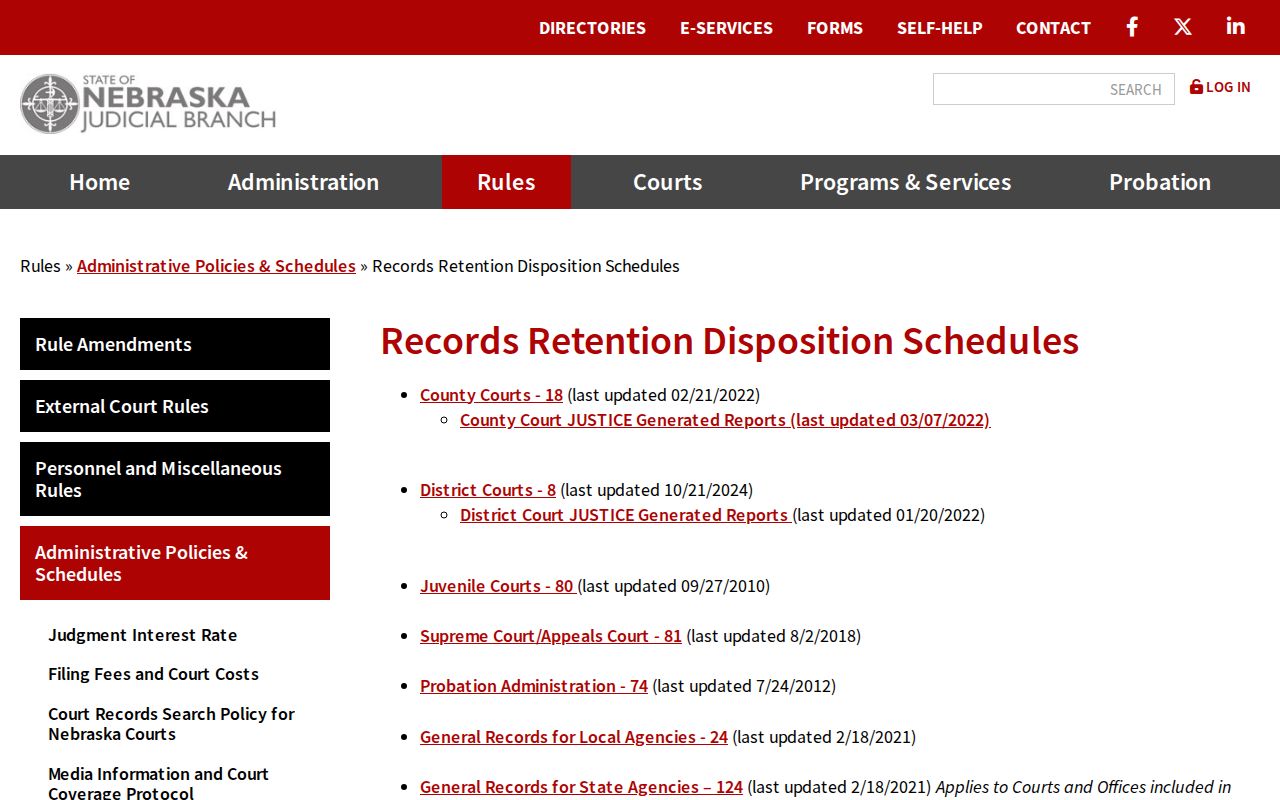
Nebraska court retention schedules explain this. Law, a schedule, or a rule can make a record unavailable. That official page is the records-retention schedule referenced for Chase County court records.
Wondering whether you can pull up a Chase County court record as an image? That depends on the clerk who holds it and the exact paper you want. One dead link proves nothing either way. Remember this too. A docket entry on the register can be public even when the document behind it never goes online.
Note: A current register entry may be public. An underlying document image may be unavailable online.
Copy Fees and Certification
Copies come in three grades. A plain copy just reproduces the page. A certified copy adds the clerk's certificate and seal, while an authenticated certificate carries three seals. The Chase County clerk lets you inspect and copy court records, but no fixed local fee schedule covers certified dockets, certified judgments, exemplified copies, staff searches, mailing, deposits, payment methods, or turnaround. Ask the price before you order anything official.
| Item | Amount |
|---|---|
| Photocopy | $0.25 per page |
| Execute certificate and seal | $1 |
| Authenticated certificate with three seals | $3 |
| Certified docket, judgment, or exemplified copy | Contact the responsible Chase County clerk |
| JUSTICE One-Time party-name search | $17 per search |
The Judicial Branch public-services page links to case search, calendar, and payment services. It can help you find a case, but a clerk-issued certification is still a separate Chase County court record service.
Chase County Special Record Requests
Certain Chase County court records take a form or a special approval path. Want a County Court transcript? Form CC 1:14 asks for the county, the case number or name, hearing date, time, location, judge, full or partial scope, exhibits, contact details, and a privacy acknowledgment. You get an estimate, pay in advance, and may owe a rush charge. A nonparty needs a judge's approval first. That form produces a typed transcript, not an ordinary copy of the register.
County audio sits outside the official court record too. The Appendix 6 form wants the hearing, courtroom, date, time, scope, delivery method, and device information. The official web and PDF fee descriptions conflict. Some restricted hearings may simply be unavailable. Check both availability and price with Karen Mueller before requesting audio.
A sealed record works differently. Form DC 1:12 is filed by the person whose record was sealed. It covers the recipient, the file scope requested, the payer, delivery choice, valid identification, and notary fields. Sealed-release rules are no shortcut to public access. The Chase County clerk can point you to the right filing route. The clerk cannot give legal advice.
Access Rules for Court Records
Nebraska public-record law backs inspection and copies, subject to exceptions and lawful charges. In Chase County, the electronic access rules reach public indexes, summaries, registers, calendars, orders, decrees, and qualifying images. Remote access and the courthouse terminal may show different things. An outage or maintenance window can also interrupt availability. A court case can be public. That does not mean every identifier or document in it is.
Key Nebraska access rules:
Nebraska Supreme Court Rule §1-803 provides equal public access to court records and information, subject to governing limits.
Nebraska Supreme Court Rule §1-805 addresses public electronic indexes, summaries, registers, calendars, orders, and images.
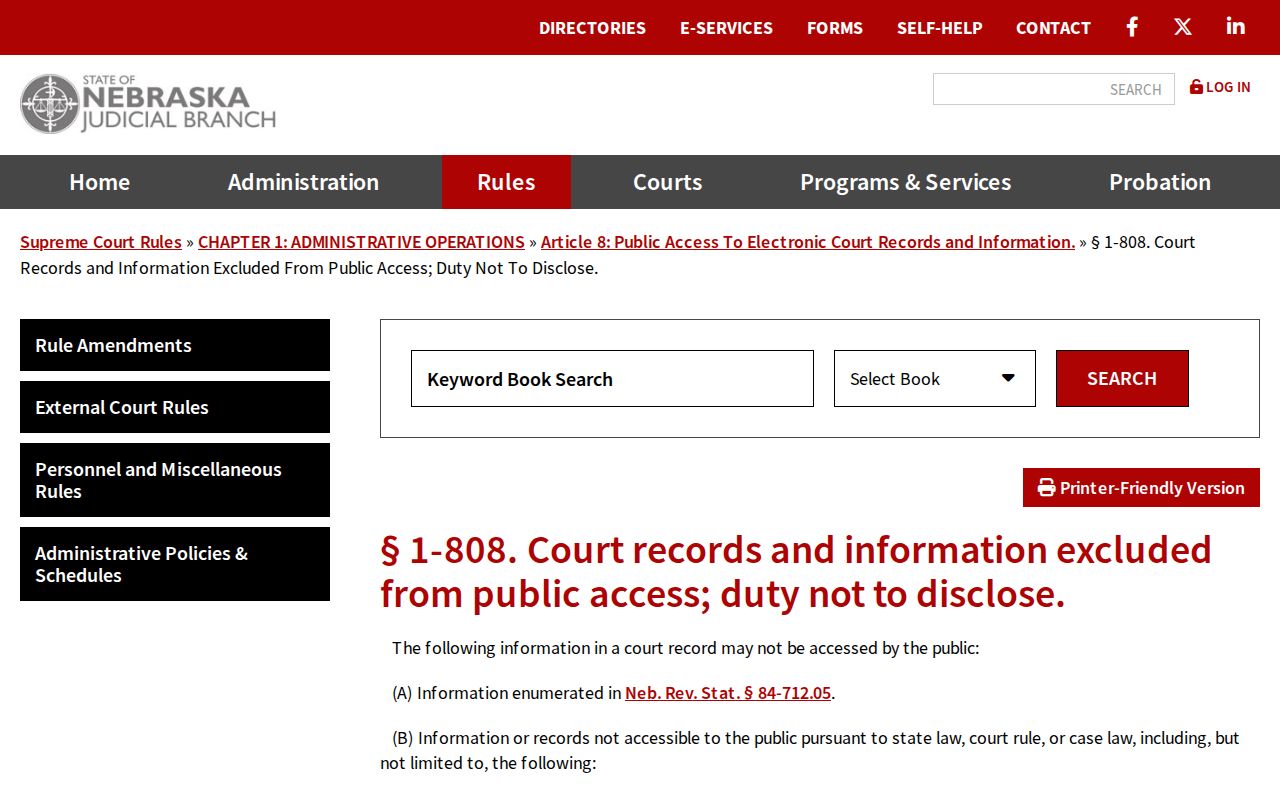
Nebraska Supreme Court Rule §1-808 excludes sealed, confidential, adoption, juvenile, criminal-history, and other protected information.
Rule §6-1464 protects specified civil personal and financial identifiers from public disclosure.
Chase County juvenile and adoption material can be confidential. Qualifying juvenile records are sealed under Nebraska procedures. Also note that a County Court set-aside order is not the same as erasing a conviction record. Parties and counsel must redact protected civil identifiers. These include dates of birth, Social Security numbers, and financial-account information. The electronic-access exclusion rule spells out what stays out of view. It also explains why a public Chase County court case search can have gaps.
Access restrictions attach to the record or the information itself, never to how curious the requester is. Ask the Chase County clerk what can be inspected or copied in the specific case you've identified.
Older Chase County Court Records
Digging into older Chase County court records? Start with the courthouse clerk. Then turn to retention or archival questions if the local file isn't there. History Nebraska's RG219 guide describes a Chase County archival lead spanning 1886 through 1977 across 58 microfilm reels. It includes a county-clerk subgroup from 1887 through 1975. Treat it as a collection guide, not a full inventory of every Chase County court file.
When the guide says no records exist, that describes the scope of the Archives collection alone. It does not prove a Chase County courthouse record never existed. Nor does it prove that no other custodial source holds material. Give the clerk the court, the parties, an approximate date, and the record type first. If the local Chase County court record is unavailable, ask a follow-up question. Does retention information or an Archives inquiry make more sense as the next step?