
Name-Based Case Searches
For a search by party name, Nebraska's paid JUSTICE One-Time search is the direct public route. It searches parties only. Witnesses do not count. Copy the spelling straight from a complaint, citation, or notice whenever you can. With a close or common name, weigh the court and case details carefully. Never trust a single match on its own.
- Open JUSTICE One-Time and read the terms before beginning a Chase County docket search. The service asks for a party name and requires acceptance of the terms.
- Enter the party name accurately. Do not substitute a witness name, and do not assume that a missing result means the person has no case.
- Complete the paid search and review the returned cases against the court, case number, case type, and party information already known.
- Use the register or contact the correct clerk when a result is recent, ambiguous, older, restricted, or absent. The court date can be checked separately on the free calendar.
| Field label | Type | Required | Notes |
|---|---|---|---|
| Party name | Text | Yes for One-Time | Search a party, not a witness; use accurate spelling. |
| Terms acceptance | Checkbox | Yes for One-Time | Accept the portal terms before starting the search. |
| Court type | Selector | No in subscriber criteria | Useful to separate County Court and District Court research. |
| County | Selector | No in subscriber criteria | Use Chase County only as needed to narrow a repeat search. |
| Case type, year, judge, or attorney | Selector or text | No in subscriber criteria | Subscriber searches support these additional filters. |
Chase County Docket Search Limits
JUSTICE One-Time is not a free, standing name index. Each search costs $17. Results cap at 30 cases and stay viewable for three calendar days. The portal warns that new entries may lag by 24 hours. A search returning nothing still gets charged. Treat the product as a paid research step. It is not a guaranteed answer.
The JUSTICE One-Time landing page is the official entry point, and it spells out the party-name search terms.
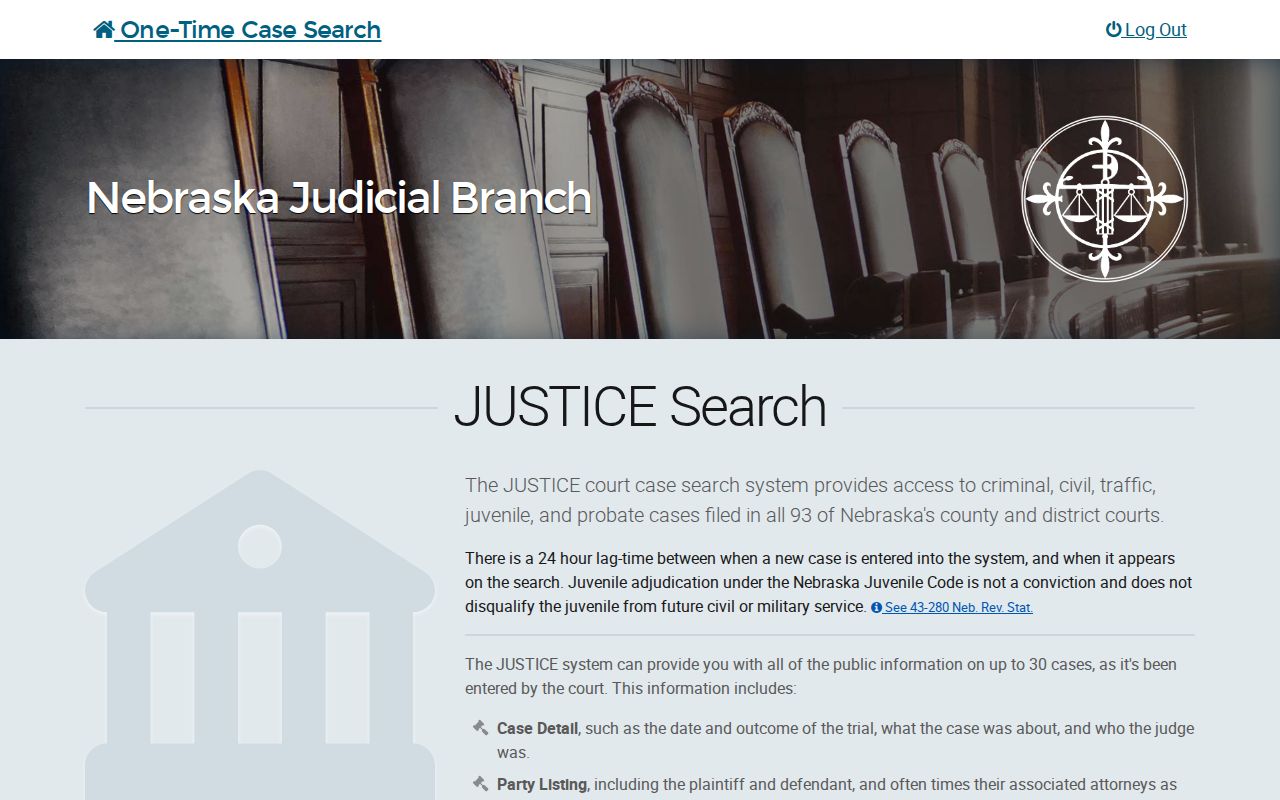
The interface shows the entry route. It is not a Chase County case result. Nor is it any private person's record.
That 24-hour lag matters most for new filings and recent court events, as does the absence of a dependable statewide through date. Check the calendar for a future setting first. Then go through the clerk if the detail you need is missing. Never draw conclusions from an empty search alone. Silence is not a result.
One caution on timing: One-Time results live in a short viewing window. Save the case number and court details you will need for a later clerk request.
Chase County Docket Search Parties
JUSTICE One-Time works on party names. A witness named in a police report or hearing is not a search key here. The portal expects a party, nothing else. If all you have is a witness, lean on the case number, a party name from the court papers, or the responsible clerk to pin down the case.
Party-name check. Compare a possible match with the case number, court, and type before relying on it. A similarly named party can appear in a different Chase County or statewide matter.
The JUSTICE search guidance draws the line between party searches and witness searches, and it covers other limits too.
Case Number Searches
A case number often beats a name for precision. Nebraska builds its numbers from three parts. Those are a case type, a year, and a sequential number. No Chase-specific punctuation pattern is documented. So keep the number exactly as printed on the court notice or search result. Do not guess at separators. The schematic shape is CR / YYYY / sequential number.
Case type points to the subject area. CI means civil, CR criminal, PR probate, TR traffic, JV juvenile, and SC small claims. Those codes help steer a Chase County docket search toward the likely court. They do not lift access restrictions. Juvenile matters run through County Court in Chase and can be confidential or sealed.
A citation number is not always a court case number. A Nebraska uniform citation may carry up to two letters followed by up to seven numerals. There are no leading zeros. If the citation fails in a case-number field, take it plus the court date to County Court. Ask there for the matching case number. Do not alter the number at random.
Chase County Docket Search Codes
Codes help sort a Chase County docket search. That can spare you a call to the clerk. County Court handles traffic, misdemeanors, ordinance complaints, small claims, probate, and juvenile matters. District Court takes felony, major civil, domestic-relations, protection-order, and administrative-appeal cases. The right code and court shrink a broad search fast.
- CI
- Civil case type.
- CR
- Criminal case type.
- PR
- Probate case type.
- TR
- Traffic case type.
- JV
- Juvenile case type, which may carry confidentiality limits.
- SC
- Small-claims case type.
The Nebraska Supreme Court and Court of Appeals sit on a separate appellate system, SCCALES, not the trial-court JUSTICE search. A Chase County trial case will not simply appear in an appellate docket on demand. Appeal and trial records live apart.
Chase County Docket Search Timing
The One-Time service says new entries can lag 24 hours. That lag is not a promise. Older records may not be complete. It is not a statewide cutoff date either.
A recent filing, payment, hearing, or order may call for another check after the entry window passes. A direct question to the clerk works too.
The free calendar works as a parallel check for a current or future setting. It cannot replace the paid case detail. It lacks the case summary, financial entries, register history, and qualifying images. If a calendar date and case information disagree, trust the later filing, order, or clerk response.
Case Search Results Explained
Click a matching row to reach the case summary. When your access level allows it, JUSTICE then opens richer detail. The summary itself usually lists the caption, case number, type or subtype, parties, judge, attorneys, status, and key dates. Detail can go further. That means offense information, assessed and paid costs, payments, Register of Actions entries, hearings or orders, judge notes, and qualifying document images. What you actually see depends on the record and the access rules that govern it.
| Case number | The court's type, year, and sequential-number identifier; compare it with the notice or citation. |
|---|---|
| Caption or parties | The case title and participating parties. A party match is not proof of identity without other case details. |
| Case type or subtype | The category that helps identify the court and subject of the matter. |
| Status and dates | Case summary information that should be distinguished from a future calendar setting. |
| Register of Actions | The chronological filing and event list, including entries such as hearings, motions, resets, orders, and dispositions. |
| Financial entries and images | Costs and payments are case entries, not certified judgments; an image is available only when it qualifies for access. |
Read the fields with care. A filing date is not a hearing date, an issued service item does not mean service was completed, and a scheduled event is not a disposition. Judge notes are case-management information, nothing more. Need a filed order? Ask the correct clerk for it.
Chase County Docket Detail Gaps
The case-detail screen is not the filed document itself. JUSTIA can show a summary, a register, and qualifying images. Even so, an image may be missing. The document may not be publicly accessible, or retention and confidentiality rules may apply. A result row is not a certified copy either. It is not a final legal judgment. It does not stand in for the complete case file. The Judicial Branch's public services page groups the court's case-information, calendar, and payment access routes.
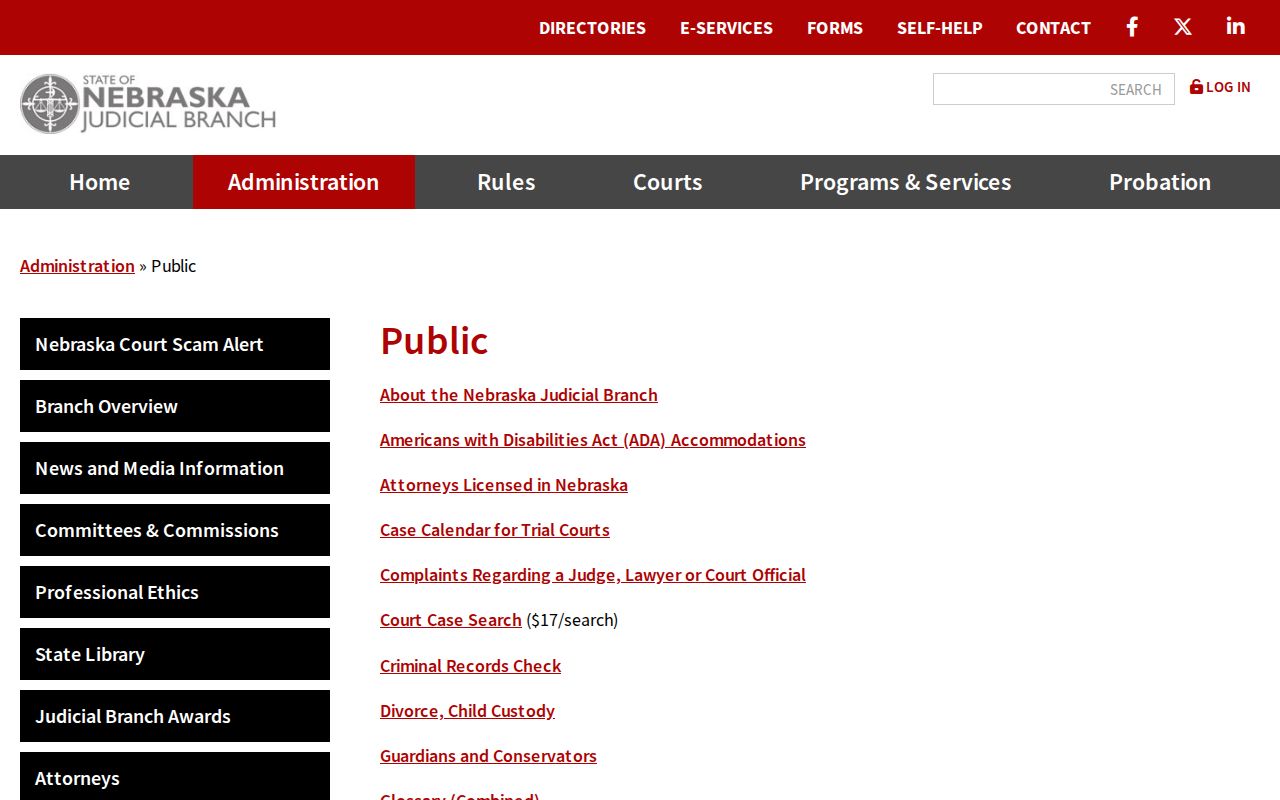
Public links help you pick a route. The clerk with responsibility for the record remains the source for inspection, copies, certification, transcripts, and audio. When a record is old, missing, or restricted, follow the documented chain rather than repeating the same search. The courthouse terminal offers public JUSTICE access during business hours. From there, the correct clerk can handle a record request, and a certified copy, transcript, audio, retention, or Archives inquiry may follow, depending on what you seek.
Chase County Docket Search Terminal
Nebraska court policy puts a public-access terminal in every county courthouse, open during business hours. In Chase County, the terminal is the documented fallback. Turn to it when the online calendar, the One-Time search, or the subscriber route fails to answer your record question. Call ahead about the room, printing, and staff help. The courthouse does not publish those details. The court-records policy also separates online search, terminal access, copies, and formal public-record requests. Use the terminal to review public JUSTICE information. Ask the appropriate clerk about inspection, copies, certification, transcripts, audio, or a restricted record. Terminal access never overrides a seal, a confidentiality rule, a redaction, or a records-retention limit.
Two Ways to Search: County and State
Chase County runs no separate public case portal of its own. The online layer for a Chase County docket search is the statewide JUSTICE toolset. One-Time is a paid party-name search across the state. Subscribers get broader criteria. They can narrow by county, court type, case type or subtype, year, judge, attorney, case number, or judgment date. The free calendar sits apart as a statewide route for current and future settings.
| Statewide route | Chase County-focused route |
|---|---|
| JUSTICE One-Time party-name search | Subscriber search narrowed by Chase County and other available criteria |
| Paid $17 search, up to 30 cases, three-day access window | $100 annual subscription; case detail is $2 per case |
| Best when a party name is the starting point | Best for repeated research or a known case number, county, year, judge, or attorney |
| Recent entries may lag about 24 hours | Still subject to access limits, data timing, and detail charges |
| Free calendar is separate and handles current or future settings | Correct County or District Court clerk handles inspection and official record requests |
The JUSTICE subscriber page describes the subscriber, bulk, and statewide-index choices.
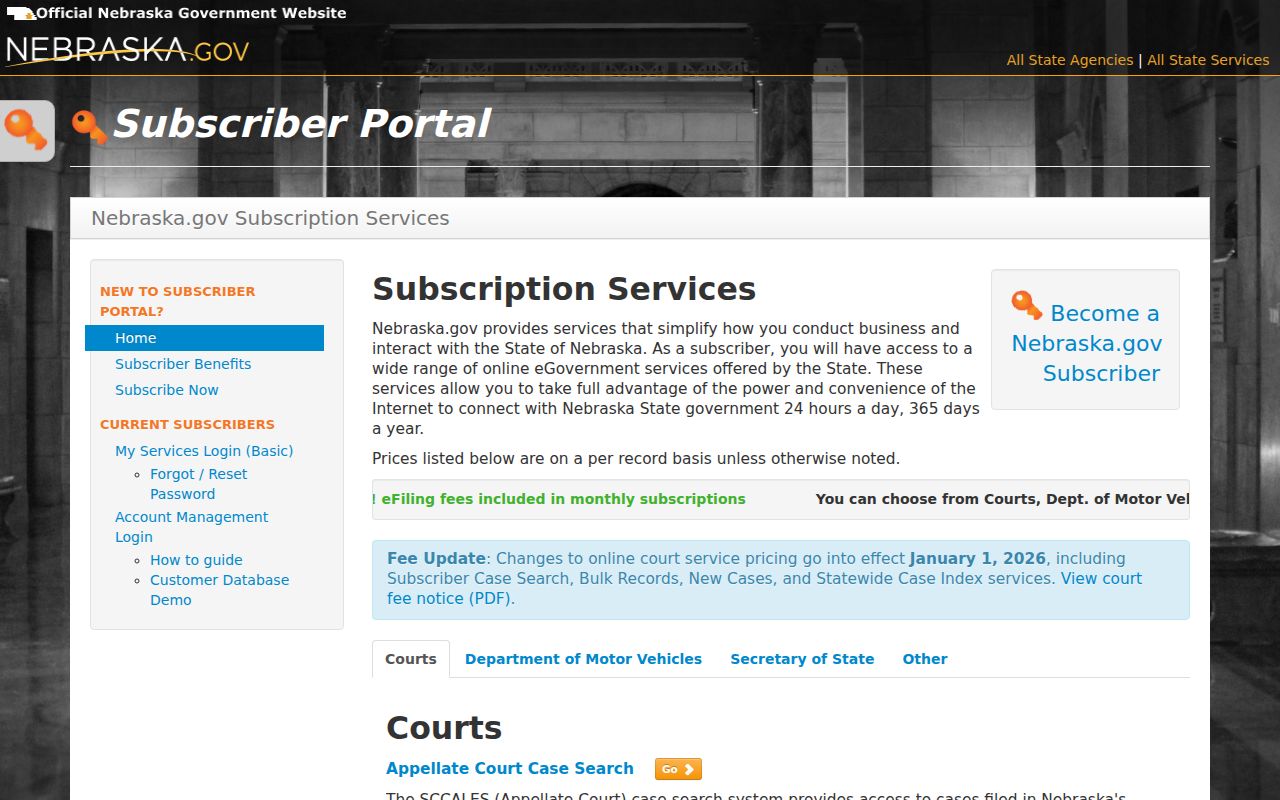
Subscriber access adds filtering power. It cannot make sealed or otherwise restricted records public.
Chase County Subscriber Docket Search
Subscriber access suits repeat research. It does not replace the court file. You can search by party, case number, or judgment date, then filter by court type, case type or subtype, county, year, judge, or attorney. The annual subscription costs $100, and detail is $2 per case. The subscription supports ten usernames. Start with the least narrow reliable information. A case number is usually the sharpest search key. Without it, begin with the party name, then add Chase County, court type, case type, and year only when the results need narrowing. Skip filters that merely seem plausible. A wrong court or year can bury the record you want. Note: The current $17 and $2 figures come from current court eServices information; older JUSTICE FAQ material may show a previous amount.
Which Cases Stay Restricted
Nebraska public-access rules allow inspection and copies, subject to lawful exceptions. The electronic-access rules treat indexes, summaries, registers, calendars, orders or decrees, and available images as part of the public framework. But Rule §1-808 excludes sealed, confidential, adoption, juvenile, criminal-history, and other legally restricted information. Chase County juvenile matters route through County Court and may be sealed or confidential. Civil records must also shield personal and financial identifiers under Rule §6-1464. An absent result can reflect a restriction, a seal, a data lag, a retention limit, or a bad search key. It does not prove a case never existed.
Chase County Docket Search Fallback
When an online docket search comes up empty, go to the office that holds the record. Karen Mueller at Chase County Court keeps County Court records for traffic, misdemeanors, ordinances, county civil, small claims, probate, guardianship, adoption, and juvenile matters. Wendy Moe at Chase District Court keeps District Court records for district civil, felony, domestic-relations, protection-order, administrative-appeal, and district appellate requests. Both offices sit at 921 Broadway in Imperial and are listed as open Monday through Friday from 8:00 a.m. to 4:00 p.m.
The courthouse also has a public-access terminal during business hours under state policy. For procedure questions or a missing record, call County Court at 308-882-7519 or District Court at 308-882-7500. A records request should identify the court, the case number or party, the case type and year, the document or date, the copy type wanted, the delivery method, and any payment or deposit question.
Need a future court date instead? That setting belongs on the Chase County Court Schedule. For a complete or certified record, use the correct clerk and the court's records-request process. A search screen is not the official file.